Meta Platforms chief executive officer Mark Zuckerberg reignited fears that the historic levels of investment he’s making to catch up in the artificial intelligence race won’t pay off, a prospect that sent shares sliding after the company raised its spending outlook for the year.
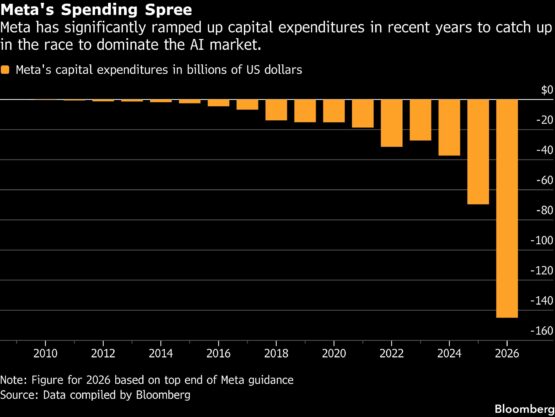
The social media giant projected full-year capital expenditures of $125 billion to $145 billion, exceeding analysts’ estimates and marking a roughly 7.4% increase from the company’s previous projections in January. Meta said the increase is partly driven by conviction that its AI strategy is working, but the company is also dealing with “higher component pricing” and additional data center costs, chief financial officer Susan Li said Wednesday on a call with investors.
Zuckerberg has said that his company will spend hundreds of billions of dollars on AI infrastructure by the end of the decade, and that was before a memory chip shortage triggered a surge in prices. Meta has announced billion-dollar deals with Nvidia Corp., Advanced Micro Devices Inc. and Broadcom Inc. for chips and other hardware just since the beginning of the year, and is building several massive data centres to power its efforts.
Zuckerberg said he has “confidence” in the decision to further boost AI spending, but that confidence wasn’t reciprocated by Wall Street. Investors baulked when the CEO failed to provide details about how Meta plans to make a return on its investments, sending shares down as much as 7% in extended trading.
The stock closed at $669.12 in New York and has gained 1.4% this year.
ADVERTISEMENT
CONTINUE READING BELOW
The higher spending “increases the stakes” for Meta given it’s using its own AI system, “which still trails frontier lab peers,” wrote Bloomberg Intelligence analyst Mandeep Singh. “So far, Meta’s stand-alone app hasn’t had the amount of engagement vs. other frontier labs.”
Meta wasn’t the only major technology company to raise spending this week. Amazon.com reported quarterly capital expenditures that were higher than analysts anticipated for expanding data centre capacity. Alphabet Inc.’s Google raised its full-year capital expenditure projections to as much as $190 billion. But Google still managed to spur a rally after beating on quarterly revenue and profit, signalling confidence in the company’s AI bets.
Meta reported $56.3 billion in first-quarter sales, beating Wall Street’s estimate of $55.51 billion. It projected sales of $58 billion to $61 billion for the current quarter, roughly in line with expectations.
Daily active people across all of Meta’s social media platforms slightly declined in the first quarter to 3.56 billion. The company cited internet disruptions in Iran and Russia’s restrictions on WhatsApp access. That marked the first drop since the company began using that metric. Li, the CFO, said Meta would have seen positive user growth absent the geopolitical conflicts.
Meta also reported first-quarter net income of $26.8 billion, which included a one-time, non-cash income tax benefit of $8 billion due to the implementation of the US tax policy signed into law in July. Analysts had estimated non-adjusted net income of $17.2 billion, without anticipating the benefit.
ADVERTISEMENT:
CONTINUE READING BELOW
More AI spending
Meta recently imposed a number of cost-cutting measures – a process Zuckerberg described Wednesday as “increasing the efficiency of our investments.” Last week, the company alerted staff in an internal memo that it would be cutting roughly 8 000 jobs and wouldn’t be filling 6,000 open roles. Meta already carried out other, more limited cuts earlier this year that hit its Reality Labs hardware division, among other teams.
Evercore ISI estimated the May layoffs will save the company about $3 billion annually, and that companies will rely more on AI agents to help handle tasks that once required human employees. “We believe the industry is just beginning to realise the growth opportunities coming out of agentic deployments – and the stepped-up level of investments required to support them,” Evercore analyst Mark Mahaney said in a note to investors.
Meta executives spent much of Wednesday’s earnings call discussing AI agents, including the fact that many employees are using them to help with product development and other tasks. Still, $3 billion is a small sliver of Meta’s total AI investments.
Earlier in April, Meta debuted its latest artificial intelligence model, Muse Spark – the first released since Zuckerberg embarked on a multibillion-dollar overhaul of the company’s AI organisation last year.
“We are already training even more advanced models,” Zuckerberg said on the call, adding that he doesn’t have “a very precise plan” for how each AI product will be scaled out.
“I think we have a sense of the shape of where things need to be,” he said, acknowledging that his answers to analysts’ questions may be “unfulfilling,” Zuckerberg said he’d provide more detail in subsequent quarters, but has historically focused on building products to be used by hundreds of millions or even a billion users before turning his attention toward using them to drive revenue.
Meta’s mounting child safety litigation poses another potential obstacle. In a landmark ruling in March, a jury found Meta liable for a 20-year-old woman’s long-standing mental health struggles, which she said were caused by her addiction to social media. While Meta must pay millions to the plaintiff, the ruling could expose the company to billions of dollars in risk from additional lawsuits. Two other bellwether cases are scheduled to go to trial in California state court later this year.
Meta acknowledged on Wednesday that it continues to “see scrutiny on youth-related issues and have additional trials scheduled for this year in the US, which may ultimately result in a material loss.”
© 2026 Bloomberg
#Meta #shares #plunge #rising #concerns #spending #spree