Something is shifting fast in the world of data storage, and Seagate TechnologyCEO Dave Mosley isn’t shy about saying so.
On the company’s fiscal third-quarter earnings call, Mosley argued that artificial intelligence is changing the very nature of how much data the world needs to store, and how urgently companies need to store it.
The numbers backing him up are hard to ignore.
Seagate beat Wall Street’s revenue forecast by more than $150 million, Reuters reported. Free cash flow hit nearly $1 billion, and the company’s forward guidance came in well ahead of what analysts expected.
AI is rewriting the rules of data storage demand
Every time you use an AI chatbot, ask a voice assistant a question, or get a product recommendation online, that interaction generates data, which needs to be stored.
Leading AI chatbots now process billions of user prompts every day. Agentic AI, systems that can act autonomously and complete tasks on their own, push that even further.
These tools continuously take in information, reason through it, and store the results.
“Agentic AI pushes this even further, transforming sporadic engagements into autonomous workflows that continuously ingest inputs, generate reasoning, and store durable outputs,” Mosley stated.
Physical AI is adding another layer.
A single self-driving vehicle can generate up to four terabytes of data every hour.
That data often needs to be retained for five to 10 years for compliance and retraining purposes.
Multiply that across thousands of vehicles, factory robots, and connected devices, and you’re looking at storage demand on a scale that is genuinely hard to comprehend.
Hard disk drives (HDDs), Seagate’s core product, are central to handling large volumes of data.
They are not as fast as flash storage, but they are far more cost- and energy-efficient at scale. That trade-off increasingly works in Seagate’s favor.
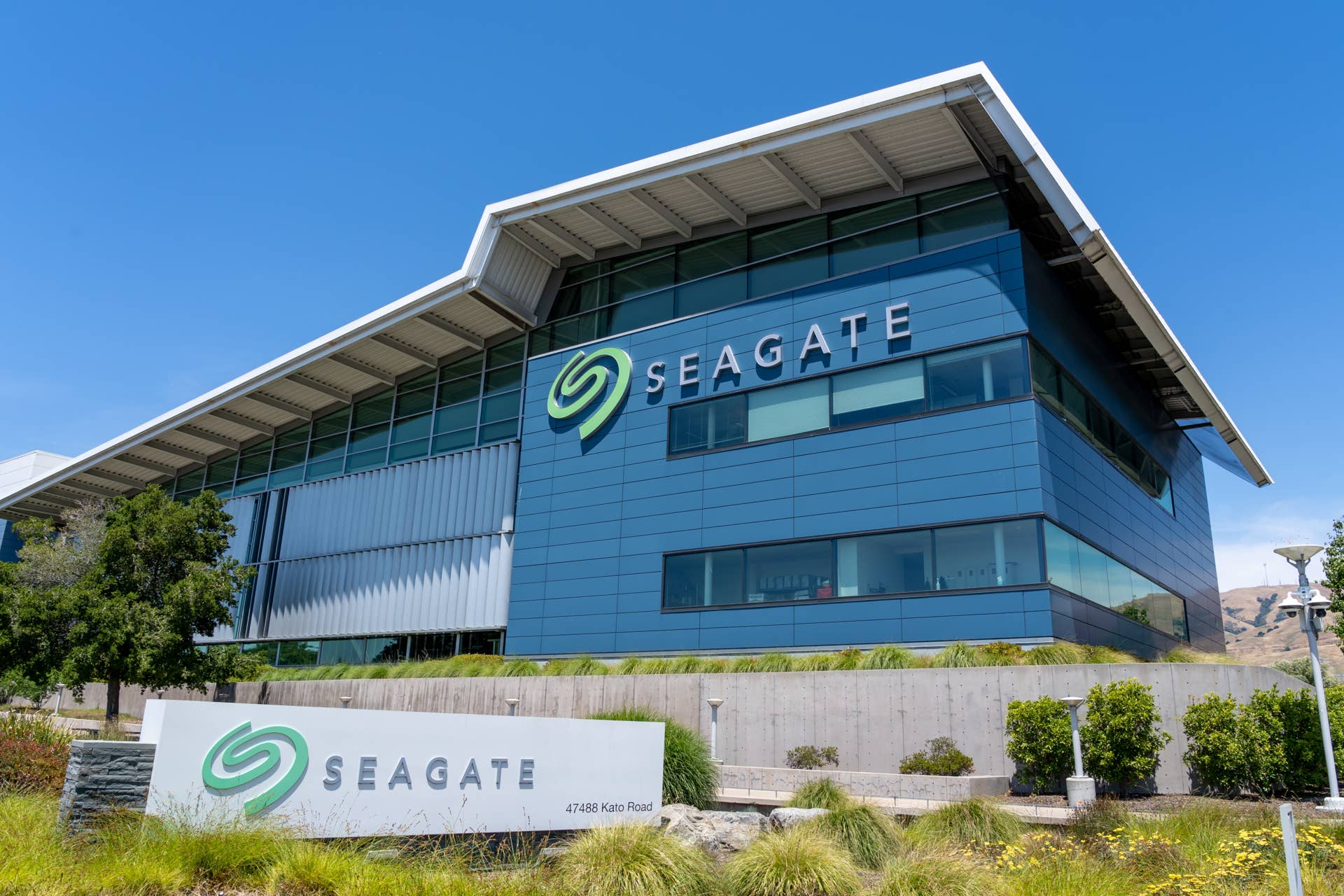
Shutterstock
Seagate’s record profits and forecast stunned Wall Street
Seagate’s March-quarter results were, by most measures, exceptional.
- Revenue came in at $3.11 billion, up 44% from a year earlier and above consensus estimates of $2.96 billion.
- Earnings per share on an adjusted basis reached $4.10, compared to $1.90 a year ago and ahead of the roughly $3.97 Wall Street had penciled in.
- Non-GAAP gross margin surged to 47%, up sharply from 36.2% a year prior.
- GAAP gross margin was 46.5%, versus 35.2% 12 months earlier.
- The company generated$953 million in free cash flow and is forecast to end fiscal 2026 with $4.4 billion in FCF.
Seagate also used the quarter to clean up its balance sheet. It retired roughly$641 million in debt and returned $191 million to shareholders through dividends and buybacks.
For the current quarter, Seagate is targeting revenue of $3.45 billion, well above the $3.16 billion Wall Street had anticipated. The company is also guiding to adjusted earnings per share of $5.00, with a $0.20 variance in either direction.
HAMR technology is Seagate’s long-term edge
None of this is happening by accident. Seagate has been investing in a next-generation recording technology called Heat-Assisted Magnetic Recording, or HAMR, which allows it to pack more data onto each disk.
Its latest HAMR-based platform, Mozaic 4+, can store up to 44 terabytes per drive —more than 30% more than the previous generation — without adding extra disks or significantly changing the bill of materials.
More AI Stocks:
- Morgan Stanley sets jaw-dropping Micron price target after event
- Bank of America updates Palantir stock forecast after private meeting
- Morgan Stanley drops eye-popping Broadcom price target
That matters because more capacity per drive means lower cost and lower power usage per terabyte for customers.
Two of the world’s largest cloud providers have now qualified the Mozaic 4+ platform, and Mosley said the timelines matched what customers see with older PMR technology, a sign the platform has matured faster than expected.
Nearline storage, the high-capacity drives that power cloud data centers, accounted for close to 90% of total exabyte shipments in the March quarter.
And that demand shows no sign of slowing. Seagate said capacity is nearly fully allocated through calendar 2027, with contracts for fiscal 2027 already locked in on pricing and volume.
The top three global cloud providers alone have nearly doubled their Remaining Performance Obligations, a measure of future committed spending, to a combined $1.1 trillion.
Mosley raised Seagate’s annual revenue growth target from the low-to-mid-teens to at least 20% over the coming years, saying the company is now entering “a period of structural growth.”
That is a bold claim. But right now, the data is squarely on his side.
Related: Seagate adds $15B in market cap on surprise news
#Seagate #CEO #sends #bold #message #data #storage