When descendants of Luigi were preparing to hand the reins of the century-old Italian coffee roaster to its first external manager, they took Antonio Baravalle to dinner, sat him down and told him what was expected.
The family knew that “sooner or later consolidation in the industry would start,” the Lavazza Group CEO recalled. His job was to make sure that when they returned to the restaurant with their competitors, the Lavazza heirs would be “looking at the menu and not be on the menu”.
Staying off the menu has required growth, and keeping up with a rapidly evolving segment to battle global heavyweights like Nestlé SA and Starbucks Corp.
When Baravalle took the helm in 2011, Lavazza derived about 70% of its revenue from Italy – leaving it undersized and overly dependent on its home market. Fifteen years later, the group has undergone a thorough transformation, with key expansion initiatives in China and the US.
“Today, over 75% of our turnover is generated outside the country,” Baravalle said in an interview in Bloomberg’s Milan offices.
Read: Italy’s Illy coffee attracts interest from JAB and Nestle
That journey continues, with closely held Lavazza targeting €5 billion ($5.95 billion) in annual revenue within the next few years, after a 16% jump to €3.9 billion in 2025. In North America, the target set in 2024 to double revenue to $1 billion by 2029 is on track, with a focus on e-commerce and retail.
“We are investing like hell in the USA,” the 61-year-old executive said.
Luigi Lavazza, the great-grandfather of the company’s current generation of owners, opened his first store in Turin in 1895. He researched the origins and characteristics of different coffee beans and studied how to blend varieties to suit the tastes of his customers.
The company grew with a vibrant Italian industry as coffee bars became local meeting places during the first half of the 20th century. With the economy booming in the late 1950s, the family began a move to industrial-scale production.
ADVERTISEMENT
CONTINUE READING BELOW
Decades later, Starbucks brought gourmet coffee to the global masses, a revolution that Nespresso machines further extended to the home. Each put pressure on others to keep up. Now there’s matcha and ube, the Instagram-able drink made from purple yams, and wide range of cold drinks.
“Lavazza has a very good heritage, and a unique branding position up there in the market,” said Jeffrey Young, who heads London consultancy Allegra Strategies. One of its biggest challenges, he said, is “the fast pace changes to the market, adapting to the new, modern style of coffee”.
Read: Coffee prices will keep rising into 2025, roaster Lavazza says
China is a prime example, where Shanghai has the highest number of coffee shops per capita of any major city in the world, Baravalle said.
In 2020 Lavazza formed a joint venture with Yum China Holdings Inc, the mainland licensee for KFC, Pizza Hut and Taco Bell. New products are rolled out every two weeks to keep up with fast-moving trends.
In a recent visit to a Lavazza café in central Shanghai, the seasonal highlight was a camellia-flavoured buffalo-milk latte that cost 36 yuan ($5.27).
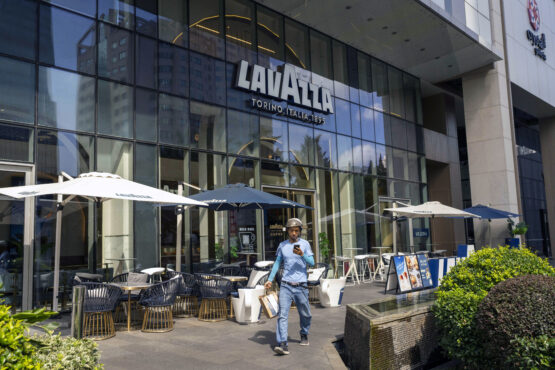
A Lavazza coffee shop, operated by Yum China Holdings Inc, in Shanghai. Image: Raul Ariano/Bloomberg
“I love innovation,” Baravalle said. “That means the category goes ahead and doesn’t transform into a commodity.”
Buffalo milk drinks are top sellers for Lavazza in China, garnering praise on social media for their creamy sweetness and nutritional value.
ADVERTISEMENT:
CONTINUE READING BELOW
Lavazza aims to have 200 shops open by year-end, up from from current 145, Baravalle said.
The original goal of reaching 1 000 coffee outlets by 2025 was pushed back by the global Covid-19 pandemic.
It’s still a long-term target, Baravalle said. But he’s happy with the Yum China partnership. The stores, decorated in a refined blue-and-white color palette, exude a light version of Italian luxury.
Read: China’s coffee unicorn is burning millions to overtake Starbucks
He sees them as essential to raising awareness of Lavazza as a premium choice for home consumers. “In China, the only way to build equity in the brands is through coffee shops,” he said.
Popping champagne
There’s a different approach in the US, a crowded yet lucrative market, with the opportunity for better markups than in Europe. Doubling Lavazza’s share from 1%-2% would mean “celebrating with champagne bottles,” Baravalle said.
The plan includes investments in areas like marketing and infrastructure, so Lavazza has the means to keep up with stock rotations at major big-box retailers, Baravalle said.
The company is expanding the production capacity of its plant in West Chester, Pennsylvania, which produces 50% of the Lavazza coffee sold in the US.
Last year, revenue surged 27% in North America – which also includes Canada, where Lavazza owns Kicking Horse coffee – mainly by retail and e-commerce.
ADVERTISEMENT:
CONTINUE READING BELOW
Despite revenue growth in 2025, coffee bean price volatility and US tariffs cut into profitability, with the margin on earnings before interest, taxes, depreciation and amortisation narrowing by 0.5 percentage points to 8.8%.
While prices have come down, they’re still 300% above 2021 levels, Baravalle said. A bigger US presence will help offset tariffs and neutralise the currency effects of dollar-priced coffee purchases that he said total $1.6 billion a year.
Read: High coffee prices are changing how – and where – people get their daily caffeine
Its heft also gives Lavazza better access to credit markets, where last month it locked in a €900 million five-year loan facility with a group of banks.
“Someone taught me to ask for things when times are good, not when things go bad,” said Baravalle, a marine biologist who earlier worked with Sergio Marchionne at Fiat Chrysler and also led Italian book publisher Mondadori.
Baravalle ruled out an initial public offering and said Lavazza has no plans for any transformational deals. So far, the Lavazza family has always rebuffed offers from suitors.
Mainly, the money is there to stay ready for opportunities as they arise, Baravalle said. When he came on in 2011, the company was in the middle of the river – the biggest of the small, or the smallest of the big coffee roasters.
At this stage, he said, Lavazza is “able to cross the river alone”.
© 2026 Bloomberg
#Lavazza #CEO #targets #China #growth #big #coffee