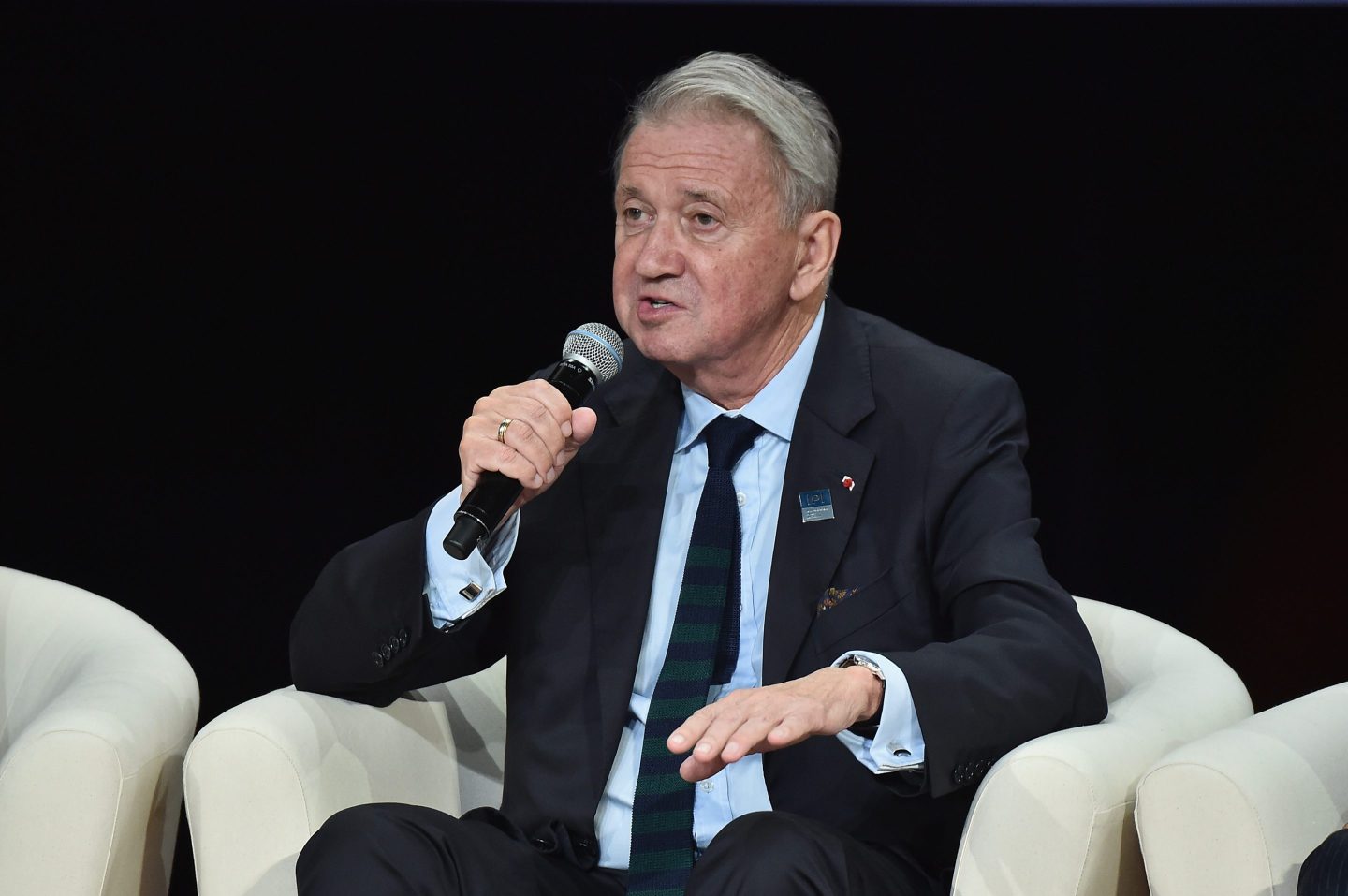
On September 12, 2015, more than three dozen health experts and diplomats assembled at the Palais des Nations, the United Nations European headquarters in Geneva, for a day-long conference on preparing for pandemics.
The bio book for the event, hosted by the International Peace Institute (IPI)—an acclaimed think tank affiliated with the United Nations that works to settle and prevent armed conflicts and was then run by one of the key architects of the Oslo Accords—was a who’s who of health experts and policymakers. Scheduled attendees and speakers included the director-general of the World Health Organization, president of the Institute of Medicine, the president of the National Academy of Medicine, an associate director of the Centers for Disease Control and Prevention, and a senior executive from the Gates Foundation (the philanthropic institution that, at the time, made up some 20% of IPI’s contributions).
Among the attendees that gathered that morning in the Palais des Nations for the discussions was Svetlana Pozhidaeva, who, by her own admission, had no expertise in epidemiology or foreign aid. Pozhidaeva, a former Russian model who was then 31, had been a so-called “assistant” to Jeffrey Epstein for about five years. She had shown up to the event wearing a dress Epstein had bought her in Paris and instructed her to wear.
In an interview with Fortune, Pozhidaeva said Epstein had told her she would be working closely with both the International Peace Institute and the Gates Foundation to orchestrate the whole event. “I will be in the middle of it, helping coordinate the whole project—that’s how he positioned it to me,” she said.
On paper, that seemed true. Terje Rød-Larsen, who was then CEO of IPI, would go on to sign a personal recommendation letter for Pozhidaeva’s visa application, a copy of which emerged in the Epstein files earlier this year, stating that she held an “active and lead role” coordinating follow-up meetings for the event and that, “without her extraordinary efforts, the fundraising would not have reached the levels it reached.”
Pozhidaeva, however, said she was held at arm’s length from the planning and never given anything to do. She said she went with Epstein to visit the Gates Foundation around that same period, but wasn’t allowed in the meeting. At the pandemics conference, Pozhidaeva recalled feeling like a fifth wheel, with attendees asking what she was doing there.
In hindsight, Pozhidaeva now sees the IPI job Epstein touted to her as “one of the hooks he used to keep me around”—yet another promise of a career opportunity she could only obtain through him that ultimately never materialized.
Pozhidaeva’s experience was part of a larger pattern.
Epstein introduced IPI to the Gates Foundation in 2013, closely advising IPI employees on what to say and how to obtain the initial $5 million donation to IPI, and working behind the scenes with an adviser to then-Microsoft Chairman Bill Gates to stimulate interest and speed up the process. The Gates Foundation would become an extraordinarily significant donor relationship for the next three years, with IRS records showing that donations from the Gates Foundation made up more than 20% of IPI’s annual donations between 2013 and 2015. Epstein would also be involved in gifts totaling $950,000 from private equity titan Leon Black to IPI. In return, Epstein used the leverage he garnered with IPI’s leadership to offer jobs or secure U.S. visa recommendation letters for at least four women in his orbit.
Emails released by the Department of Justice earlier this year, alongside Pozhidaeva and another assistant’s personal accounts, show how Epstein used and leveraged the brands of a respected think tank and one of the most important philanthropic institutions in the world as instruments to control and traffick women—all while he was already known to be a registered sex offender. Except where otherwise noted, mentions of emails, text messages, and documents refer to items released publicly by the DOJ.
After his 2008 conviction for soliciting an underage woman for prostitution, Epstein began recruiting young-looking foreign women over the age of 18 who were abroad or already within the U.S. on the promise of jobs, education, and career opportunities—a pattern documented by women’s personal accounts and several lawsuits in the years since Epstein died by suicide in a jail cell. Often referring to them as his “assistants,” Epstein helped them obtain visas and pay for their accommodation, clothing, and education—later demanding gratitude and obedience to his commands, and conveying that they owed him for his generosity. Sometimes he would pay for or demand that they recruit other women. Many of these assistants were from Russia or Eastern Europe—some of them poor and still learning English—and they became dependent on Epstein for visas, housing, and money. Several of the assistants, including Pozhidaeva and another who shared her personal account with Fortune, say they were repeatedly sexually abused by Epstein during the course of their time in his orbit.
Epstein’s regular engagement with politicians and tech executives—and his affiliation with prominent institutions like the International Peace Institute or the Gates Foundation legitimized Epstein, according to Pozhidaeva, and made her hesitant to question whether the career opportunities he was offering were real or not.
“Being able to meet tech executives or prime ministers when you come from a small country or from Russia or Ukraine—it changes your perspective,” she says. “If someone like this comes to [Epstein’s] house, maybe it’s me who doesn’t understand something here.”
Another former assistant, who Fortune is referring to as Marna in an effort to protect her identity from becoming known, told Fortune in an interview that Epstein’s proximity to important people—and witnessing him leverage those relationships as if they owed him something—made the threats he made, or the stories he told, all feel equally true.
“For a foreign woman in her early 20s with limited English, that framing was extremely powerful,” she said. “It made him seem untouchable.”
In response to comment for this story, an IPI spokesperson said in a statement that the think tank “continues to be very troubled by the documents released recently by the US Department of Justice relating to Jeffrey Epstein” and that it “joins with those around the world who have expressed solidarity with the survivors of Epstein’s wrongdoings.”
“IPI is aware of the connection that once existed between Epstein and IPI’s former President Terje Rød-Larsen, a connection IPI acknowledged in 2020 when it announced Mr. Larsen’s resignation. IPI no longer has contact with Mr. Larsen or his executive staff,” the statement said.
The Gates Foundation said in a statement that “the harm Epstein inflicted on women and girls was horrific, and no one should ever have to experience what they did. It’s deeply troubling that, without our knowledge, Epstein used the Gates Foundation’s name to further his agenda.”
There has been no evidence suggesting that Rød-Larsen was personally involved in abusing any women himself, nor that he was aware that Epstein was abusing the women he helped procure jobs and visas for. The law firm representing Rød-Larsen pointed Fortune to statements it has issued in recent weeks on Rød-Larsen’s behalf, including from his lawyer John Christian Elden, who said earlier this year that Rød-Larsen has “previously expressed regret for his association with Epstein and has clearly distanced himself from Epstein’s actions. He has expressed deep sympathy for those affected, and acknowledges that in hindsight he should have exercised greater caution.”
A representative for Black did not respond to Fortune’s requests for comment.
‘Bill approved the 5 million’
It was Jeffrey Epstein who first introduced the Gates Foundation and IPI. Epstein, via his friendship with its president, Rød-Larsen, had already been tied to IPI for a few years. By 2011, Rød-Larsen was visiting Epstein’s house in New York City and had stayed in his home in Paris, and visited his island. In 2013, he personally borrowed $130,000 from Epstein, as was first reported by the investigative outlet DN and later confirmed in DOJ emails.
Emails released earlier this year by the Department of Justice show the extent to which the relationship was professionally intertwined, too. Rød-Larsen regularly turned to Epstein for fundraising advice and sent him private IPI documents or exchanges to review. Several other IPI employees, including the director of its Vienna office, corresponded with Epstein via email. Epstein sponsored a fellowship with IPI in 2012, and an email shows that IPI was trying to arrange payment to Epstein for serving on IPI’s Mongolia Presidential Advisory Board, where Epstein and a group of others gave direct advice to the then-Mongolian President Tsakhiagiin Elbegdorj.
“I didn’t see a way out for myself”
Svetlana Pozhidaeva, former assistant to Jeffrey Epstein
By the time that Epstein introduced Bill Gates to IPI’s senior leadership in March 2013—around the time of a meeting at the residence of then-Nobel Committee chair Thorbjørn Jagland—Epstein had already been working behind the scenes to secure the donation.
He had been corresponding with Boris Nikolic, Bill Gates’ then advisor and someone who regularly interfaced with Epstein, about IPI—sending him information about the Institute and its work to eradicate polio for Nikolic to relay to Gates at the end of 2012, emails show. Over the next several months, Epstein would work meticulously—reviewing and editing emails to Gates Foundation employees and pushing Nikolic about the donation.
In a statement to Fortune, a spokesperson for Nikolic said: “As the emails show, discussions between IPI and the Foundation focused on expanding polio vaccine access in underserved regions,” declining to comment further.
“Bill approved the 5 million,” Epstein wrote to the head of IPI’s Vienna office when giving her advice about an upcoming conversation with the Foundation. “Ask them if they read your analuysis [sic] of the situation,” he said.
Epstein’s efforts were fruitful. In 2013, the Gates Foundation committed $5 million to IPI to support polio eradication, and Epstein himself emailed Nikolic the wiring instructions for the money.
It wouldn’t stop there. Over the next seven years, between 2013 and 2020, the Gates Foundation donated more than $8.5 million to IPI, public records from the foundation show.
Bill Gates, shown here in a January photo, issued an apology to Gates Foundation staff in February for his personal correspondence and interactions with Epstein and the reputational risk those actions posed to the foundation’s work.
Stefan Jerrevang—Getty Images
At the onset, emails released by the Department of Justice show that Nikolic was trying to speed up the grant-making process, which he said in an email typically took six to nine months. “We are trying to accelerate,” he wrote in an email to Epstein and the head of IPI’s Vienna office in August 2013. Within one month of that email, several IPI staffers flew out to Seattle to meet with the Gates Foundation, and in October, the $5 million grant was awarded, and $2.5 million was wired to IPI.
At least one of the employees of the Gates Foundation was surprised by the speed with which the Foundation moved forward with IPI. A former employee at the Foundation at the time, who worked on the organization’s polio eradication strategy, recalls running into someone from IPI approximately a month after they first heard about the talks, and was surprised to learn that person was already laying the groundwork for it. “I thought it was rather quick for a higher level grant.”
What employees at the Foundation did not know is that Epstein had been using multiple channels and personal connections over several years to try to influence Bill Gates, as Fortune has detailed in earlier reporting.
Epstein would get involved lining up another donor to IPI, too. In 2014, the private equity scion Leon Black made two personal donations, totally $950,000, to the think tank—donations Epstein was corresponding and asking about, emails show.
As it turns out, there would be some favors Epstein would want from IPI in return for his generosity.
‘That’s the story you need to tell’’
In August 2018, Marna, the foreign assistant in her early 20s at the time, texted Epstein that she had heard back from the Swiss Embassy in Washington as she was trying to secure her student visa. Her papers had not been approved.
Within 15 minutes, Epstein had messaged Rød-Larsen, who had previously agreed to help with the visa. Rød-Larsen responded to Epstein within a few minutes, saying he would reach out to an ambassador and “ask him to speak to the Consul General.”
Soon after, Epstein and Rød-Larsen had apparently come up with a solution. Epstein texted Marna: “You have been working for international peace institute terje larson,” he wrote.
Marna, seemingly confused, asked if the message was meant for her.
“yes if you get a calll [sic]; thats the story you need to tell,” he instructed.
Other women, however, had more direct connections to IPI. While an exact tally of women in Epstein’s orbit who worked for IPI could not be learned, Fortune confirmed two of Epstein’s assistants, including Pozhidaeva, held roles on staff at IPI, and additional email exchanges reviewed by Fortune show that Epstein either floated IPI as a potential career opportunity or a means to secure a visa application for at least two more.
“Epstein would find something each of us wanted, something appealing, and use it as leverage”
Marna, former assistant to Jeffrey Epstein
Epstein’s numerous attempts to leverage the connections he had secured for Rød-Larsen’s organization would ultimately capture the attention of authorities.
In December 2019, a liaison prosecutor from the Norwegian Ministry of Foreign Affairs sent a memo to the U.S. Department of Justice, according to an email exchange within the files. This was several months after Epstein had died by suicide in New York after being arrested by the Department of Justice. The memo included testimony from an IPI employee, saying that the individual had been “asked on more than one occasion to attend to very short-term trainees from Eastern Europe” during their time working at IPI between 2014 to 2016.
“These trainees were all young, beautiful females, and without the education required to work at the think tank,” the memo read, adding that some of the women took pictures at the UN that were later sent to Epstein.
“We’ll incorporate it into our investigation and/or follow up as appropriate,” the Assistant U.S. Attorney General for the Southern District of New York wrote in response to receiving the information from a Department of Justice liaison prosecutor who passed it along.
In a January 2014 exchange with a woman, whose name is redacted in the records apart from her initial, “M,” Epstein offered up work at IPI as one of his “many ideas” he had for her.
“Also peace institute in vienna sounds like a great idea,” M responded to Epstein. “Please tell me more details? I still receive options from my booker but modeling is not my goal anymore. Thank you for great offers and aid.”
Terje Rød-Larsen resigned as president and CEO of the international Peace Institute in 2020, the same month that information about his ties to Epstein came to light.
Theo Wargo—Getty Images
Pozhidaeva had a degree from the Moscow State Institute of International Relations and had been modeling for a European fashion brand before meeting Epstein, who had helped her secure a U.S. visa and secure her housing, as the Wall Street Journal first reported. Pozhidaeva would work at IPI on and off between around 2012 and 2016, she recalls. Emails she shared with Fortune show notes she took from a meeting she sat in with Azerbaijan President Ilham Aliyev, as well as her attending a trip to Kazakhstan. Pozhidaeva was also included in logistical correspondence regarding a trip that former U.S. Treasury Secretary Larry Summers took on behalf of IPI. “I felt like I was so out of place,” she told Fortune about her time attending the pandemics conference. “People were making comments that I looked very young.”
A separate Russian model and Epstein assistant named Ada, who’s real name Fortune is withholding in an effort to protect her privacy, also got a job as a result of the Epstein-IPI connection. She worked at IPI as an intern, a full-time employee in a newly created “external relations assistant” position, then a volunteer (due to her visa status) for more than two years, according to one of the woman’s offer letters of employment as well as an email to Rød-Larsen from an IPI employee that outlined the woman’s role and how much she had cost IPI during her time at the organization.
“Total expense to IPI between October 2016 and July 2018 was an estimated $71,000,” the employee wrote to Rød-Larsen in February 2019.
Epstein confirmed in an email exchange with Ada that he was bankrolling Ada’s salary at IPI himself.
“Didn’t you give them 100k for my full-time employment?” Ada asked Epstein in January 2018.
“You are right,” he responded.
During her time at IPI, Ada gave Epstein updates about her work at the think tank, and alerted him when she had co-published an article about water conservancy on IPI’s site.
“My first piece on water published!” Ada enthusiastically emailed to Epstein in April of that year. She would go on to co-byline another Q&A as well.
In one exchange, Epstein even floated a job directly at the Gates Foundation. “You could work for the human rights comminsion [sic] in strausberg, gatees foundation [sic] in ivory coast. etc,” he wrote in an email in January 2014 about a potential summer internship.
‘I hadn’t a clue’
IPI proved to be a particularly alluring opportunity to some of his assistants, due to its affiliation with high-profile institutions like the United Nations and the Gates Foundation.
“Those are some of the most respected international organizations in the philanthropic world,” Pozhidaeva says. Pozhidaeva shared an email with Fortune that she had sent in 2012 to her mother, who was still in Russia, where she excitedly told her that Epstein had relayed that conversations with IPI seemed to be moving forward.
Epstein dangled opportunities to perpetuate sexual abuse and recruit more women into the fold, the former assistant Marna explains. “Epstein would find something each of us wanted, something appealing, and use it as leverage. Sometimes he would actually deliver: an internship at IPI… or a semester or a course at a good school. And whenever he did this for someone, he made sure to brag about it to everyone else,” she said. “He would then use the promise of providing something similar—the mirage of it—to continue the abuse, to keep the women tethered to him, and to pressure them into recruiting others.”
That such established institutions could end up so intertwined with a sex offender is now puzzling insiders, who were never aware the organization they worked for had any ties to Epstein until earlier this year.
“I hadn’t a clue about Epstein,” says the former employee at the Gates Foundation, who says they were shocked to learn that Epstein had been involved in the IPI grant and had corresponded with Gates.
Since the latest batch of the Epstein files, Bill Gates issued an apology to Foundation staff during a town hall in February over his personal correspondence and interactions with Epstein and the reputational risk it has posed on the Foundation’s work, as was first reported by the Wall Street Journal. In March, the Foundation commissioned an external review ?to assess?its past “engagement with Epstein” and to review its current policies for vetting and developing new philanthropic partnerships. “That review is underway, and we expect?the board and management will receive an update?this?summer,” the Foundation wrote in a statement that was published in April.
Rød-Larsen resigned as president and CEO of IPI in 2020 the same month that information of his ties to Epstein was first reported by the investigative outlet DN. In the weeks since the latest release of DOJ documents from the Epstein files, Rød-Larsen’s wife, Mona Juul, resigned as Norway’s Ambassador to Jordan and Iraq, and Norwegian authorities have opened corruption investigations into the two of them. In statements, both individuals have denied the charges. Their son, Edward Juul Rød-Larsen, whom Epstein had mentored and left $5 million to in his will, died by suicide in April. He was 25.
The lawyer representing Rød-Larsen, John Christian Elden, said in a statement earlier this year that Rød-Larsen is “currently seriously ill” and “has recently suffered multiple strokes and is significantly cognitively impaired.”
“This causes major difficulties for him in expressing himself both in writing and orally, and it also complicates the legal team’s work in establishing the facts,” Elden wrote. “I ask for calm and human consideration towards Rød?Larsen and his family at this time.”
At IPI, there has been a reckoning over its ties to Epstein for several years now. After Rød-Larsen’s resignation, the subsequent acting chief executive of the Institute moved swiftly to address financial ties to Epstein that had begun to surface. The board commissioned an internal forensic audit, and made those results public.
But that audit focused squarely on the financial trail between Epstein and the think tank. It never mentioned that it was Epstein himself who had brokered one of the Institute’s most important grantor relationships, and IPI said that its review found “no evidence of Epstein deriving any personal benefit from IPI in exchange for his donations.” It didn’t acknowledge that Rød-Larsen had helped secure visas for women in Epstein’s orbit, nor that Epstein had placed women who worked for him directly on the IPI payroll and at some of its events or trips.
For those women, such as Pozhidaeva, details of their presence at IPI are only just coming to light.
Pozhidaeva says she has since forgiven Rød-Larsen for his role. She went on to cofound a venture capital fundraising platform and says she is proud of her current career. But she says that the IPI job, while impressive on paper, didn’t help her in that effort; it was primarily used by Epstein to entice her to stay put. Despite Epstein’s promises, Pozhidaeva obtained no real experience, work, or connections to start a meaningful career, she says. Indeed, the gaps in her resume seemed to widen the longer she stayed with him, and she felt trapped.