Rivian is getting proactive about its future as it looks to chip away at the electric vehicle market that is dominated by Tesla.
To catch its rival, Rivian understands that to compete with Tesla, it must be more than just a car company; it must also be a technology leader.
Many of its recent announcements have focused on investing in hardware and compute infrastructure while developing an end-to-end AI autonomy system that scales, and harnessing a “shared data foundation” that it says will transform the ownership experience for its customers.
Now the company is considering making a key component that powers the self-driving tech.
Rivian eyes in-house lidar production
Rivian may produce the lidar sensors that enable the self-driving tech it is developing in-house, CEO RJ Scaringe told Reuters this week.
Rivian says it plans to include lidar sensors on a version of its R2 vehicle coming later this year, but did not disclose which company would supply them.
The company is considering going in-house, possibly through a joint venture, as “all the real choices are coming out of China,” according to Scaringe.
“Think ?of ?it as finding a way to structurally ingest the technology,” Scaringe told Reuters. “The advancements in terms of going from the early lidars that I think a lot of us have seen — we see them here — to these much more advanced solid-state lidars, those advancements didn’t happen in the United States. Those advancements happened in China.”
Rivian is not just in active discussions with lidar firms. Its efforts could also include other automakers, who are “thinking about how they could do that either together, or at least through shared alignment to say, ‘Hey, let’s develop production capacity in the United States for this, or at least outside of China,'” Scaringe said.
Lidar from China poses potential national security issues, as real-time image and terrain mapping is a key part of the technology.
Meanwhile, Tesla CEO Elon Musk has called lidar an “expensive and unnecessary” fool’s errand that is just “expensive hardware that’s worthless on the car,” CDO Trends reported.
Recently, Tesla said that its FSD system has driven a cumulative total of 3.6 billion miles, nearly triple the 1.3 billion miles it reported a year ago.
In March, the National Highway Traffic Safety Administration shared that it was escalating its investigation into FSD partly because its camera-based system may not be adequate.
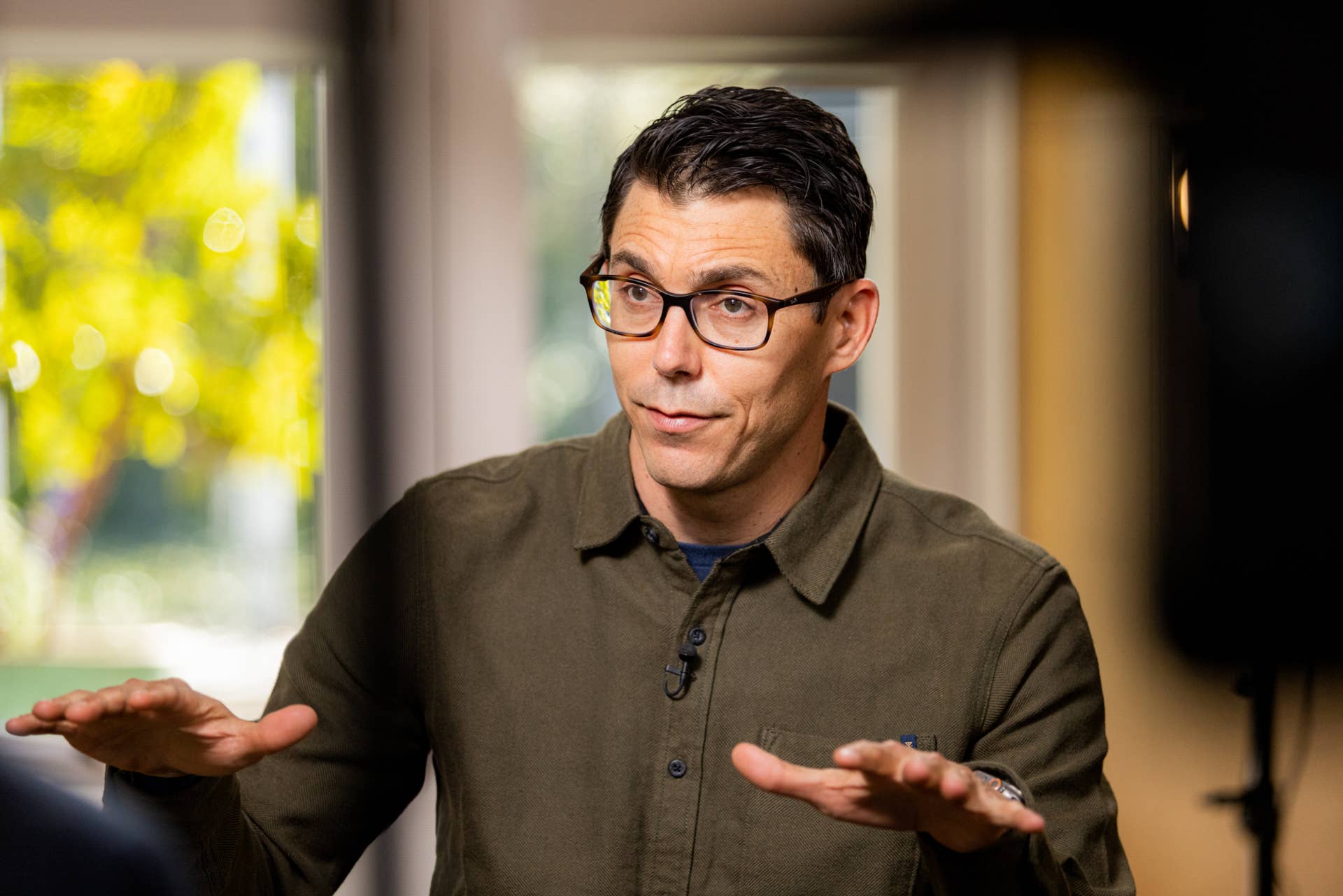
Photo by Bloomberg on Getty Images
Rivian believes lidar gives it the edge over Tesla
Tesla Full Self-Driving (Supervised) is an industry-leading advanced driver assistance system, and Rivian believes it will have the technology to surpass it, since Tesla’s autonomous driving tech relies solely on cameras.
Lidar (light detection and ranging) uses laser lights to measure distances and create more precise 3D maps, and Rivian says the tech “provides detailed, three-dimensional spatial data and redundant sensing,” adding another layer of safety to its system.
Related: Tesla FSD makes terrifying mistake in viral video
During its Autonomy & AI Day in December, the company introduced the Gen 3 Autonomy Computer, its third-generation compute platform, which it says will have the “leading combination of vehicle sensors and inference available in North America.”
The Gen 3 Autonomy Computer can process 5 billion pixels per second, thanks to the Rivian Autonomy Processor, its proprietary silicon chip that Rivian claims is among the auto industry’s first multi-chip modules used in high-compute applications.
Rivian’s current hands-free system features 10 HDR cameras and five radars and costs $49.99 per month for a subscription and $2,500 to purchase.
BNP Paribas sees big upside for Rivian stock
Elon Musk has promised investors that Tesla will more than triple its Robotaxi coverage and usher in the humanoid robot revolution by the end of the year.
Meanwhile, Rivian’s goals this year seem much more attainable, so analysts at BNP Paribas are more bullish on the struggling startup EV maker.
More EV news
- Consumer Reports names 5 popular EVs with the best real-world range
- Morgan Stanley names top auto pick if gas prices stay high
- Safest carmaker issues recall over dangerous EV issue
The firm says that while it expects better deliveries, “Rivian’s 2026 will be defined by… the Co.’s ability to offer FSD-like ‘point-to-point’ hands-free driving by year end.”
All Rivian vehicle deliveries now come with a 60-day trial of Autonomy+, its hands-free platform.
In the meantime, it says the recent $1.25 billion expanded Robotaxi partnership with Uber is enough to push the firm’s expectations for Rivian’s stock to $4 per share.
On March 19, Rivian and Uber revealed a partnership in which Uber will invest up to $1.25 billion in Rivian and deploy as many as 50,000 autonomous R2 vehicles on its ride-hailing platform in two years.
“We couldn’t be more excited about this partnership with Uber — it will help accelerate our path to level 4 autonomy to create one of the safest and most convenient autonomous platforms in the world,” Rivian CEO RJ Scaringe said.
In a recent note, analysts at JPMorgan praised the deal as “mostly positive,” noting that the extra cash will come in handy as Rivian navigates what they described as a “seemingly increasingly structurally unprofitable” market for electric vehicles.
Driven by a strong first half of the year, Rivian closed 2025 with an annual gross profit of $144 million as revenue increased 8% to about $5.4 billion, but to JPMorgan’s point, much of that profit was driven by its software and services segment, since Rivian’s automotive business lost $432 million last year.
Related: Rivian defies expectations despite rough EV environment
#Rivian #challenging #Tesla #FSD #latest #move