Most car buyers shop the way they buy a mattress. They walk in with a number in their head, walk out with a bigger one, and try not to think about it for the next six years.
Electric vehicles have spent the better part of a decade making that math worse. The average new EV ran roughly $8,000 above the average new gasoline car at last count, and the federal tax credit that used to soften the blow vanished on September 30, 2025, when the One Big Beautiful Bill Act took effect.
New EV sales cratered 28% in the first quarter of 2026 as a result, with the credit gone and sticker prices barely moving, according to Cox Automotive.
That’s the front lawn of the EV market. The back lot looks completely different.
The used aisle that has barely moved for years is suddenly the most active corner of the dealership, and a fresh forecast from Edmunds suggests it’s about to get a lot more crowded. For the first time, the affordable EV that automakers keep promising to build may already be sitting on the used lot.
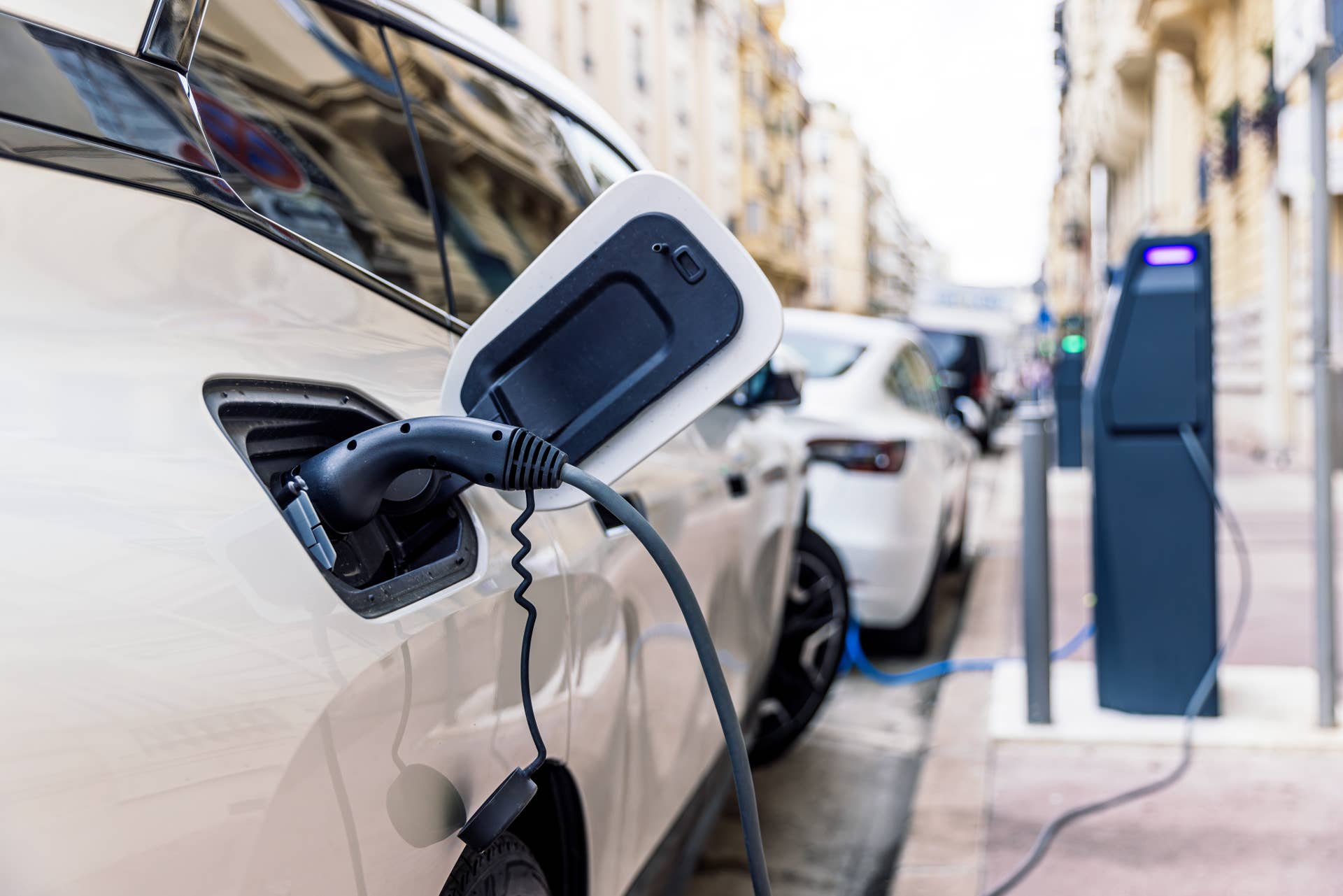
Photo by Alexander Spatari on Getty Images
What just happened with used EV prices
The headline number jumped out at me when I worked through the latest Cox Automotive data. Used EVs are now selling for an average of $34,653, just $1,102 above the $33,641 average for a used gasoline car, according to CNBC.
A year earlier, that premium was $3,923. The gap has shrunk by nearly three-quarters in twelve months.
Sales volume is keeping pace. Used EV transactions jumped 27.7% in March from a year earlier, and were 53.9% higher than February, according to Cox Automotive.
The mix has also shifted toward genuinely affordable cars. In March, 44% of used EVs sold for under $25,000, up from 39% in December, according to Cox Automotive industry insights director Stephanie Valdez Streaty.
More Automotive:
- Hyundai admits deadly defect caused more injuries than previously known
- Consumer Reports names 5 popular EVs with the best real-world range
- Uber targets 50,000 robotaxis in major Rivian, Nvidia deals
“We are approaching price parity,” Valdez Streaty said.
That parity matters most in the segment where most Americans actually shop. A three-year-old Tesla (TSLA) Model 3 or Hyundai (HYMTF) Ioniq 5 priced under $25,000 lands in the same monthly-payment territory as a Honda Civic or Toyota Camry, and it brings substantially lower fueling costs along for the ride.
Why a wave of lease returns is rewriting the used EV math
Behind the price collapse sits a supply story most consumers never see. The share of EVs among lease returns is projected to jump to 8% in 2026 from just 2% in 2025, according to Edmunds.
The math traces back to a leasing surge that no one in the showroom fondly remembers. “Where we had the highest concentration of leasing happen was between the tail end of 2022 and all the way through 2023, and since most leases are three years long, all those cars… are coming back to dealer lots in droves,” said Joseph Yoon, a consumer insights analyst at Edmunds, in remarks to CNBC.
Total volume is the punchline. Edmunds expects roughly 400,000 additional lease returns to hit the market in 2026 across all powertrains, with as many as 215,000 of those being EVs specifically, according to Cox Automotive data shared at its Q1 industry call and reported by Autotrader.
The vehicles in that pipeline are not beat-up rentals. Most are 2022 and 2023 models with fewer than 40,000 miles, often still inside their factory warranties and the federally mandated eight-year battery coverage.
The brand mix is broadening too. Roughly half of EV lease maturities heading into 2026 are Teslas, with the share shifting toward mainstream brands like Hyundai, Chevrolet, and Ford (F) as the year progresses, according to Cox Automotive data cited by Autotrader. The Ford Mustang Mach-E now sells used for an average of $28,970, according to an Inside EVs report.
What used EV economics mean for your monthly budget
When I ran the numbers against a typical commute, the used-EV monthly math holds up better than most buyers expect, even without the tax credit. Three figures explain why:
- Charging an EV at home for 1,015 miles a month costs about $59.66, based on average residential rates of 17.65 cents per kilowatt-hour.
- Driving the same distance in a 30-mpg gas car costs roughly $147.24 at $4.09 a gallon.
- Public fast charging for that same mileage runs about $169 at 50 cents per kilowatt-hour.
Source: CNBC
There are catches buyers should price in. EVs eat through tires faster because they weigh more. Some cars also lock features behind manufacturer subscriptions that don’t transfer with a used purchase, said Yoon.
And the up-front cost of installing a home Level 2 charger can run from about $500 for the unit alone to several thousand dollars when a panel upgrade is needed, also said Yoon.
Federal tax credits worth up to $4,000 on used EVs and $7,500 on new ones expired on September 30, 2025, under the One Big Beautiful Bill Act, according to CNBC. State-level rebates and utility credits remain available in many regions.
What buyers should watch through the rest of 2026
The strangest part of this story is that one of the auto industry’s loudest skeptics of mass-market EV pricing has become its loudest advocate for used ones. “Used EVs are super popular right now. So the market has changed,” said Ford CEO Jim Farley, on the Rapid Response podcast, as quoted by Inside EVs.
Ford has since pulled back its premium electric ambitions, including discontinuing the F-150 Lightning, and is targeting a $30,000 to $35,000 sweet spot for its next generation of vehicles, according to Fortune.
There’s a second-order effect worth tracking. Cox Automotive projects EV lease returns will keep ramping through 2028, which suggests this isn’t a one-year sale event. The cars hitting lots this year are the leading edge of a multi-year supply wave, and that wave is what’s holding the lid on used EV prices even as new EV demand cools.
For shoppers, the practical takeaway is simpler. The cheapest electric car of 2026 is not going to roll off a Detroit assembly line in the next twelve months. It already came off lease in Atlanta or Phoenix or Sacramento, and it’s sitting on a dealer lot waiting for someone to do the math.
That’s the kind of arithmetic worth running before signing on the next car loan.
Related: Why used EVs are now the most affordable car option in America
#Edmunds #reveals #surprising #outlook