Anthropic is dramatically expanding its footprint in financial services, launching a suite of pre-built AI agents for the world’s largest banks and debuting Claude Opus 4.7—its most capable model for financial work yet. The announcements, made Tuesday at the company’s invite-only financial services briefing in New York, cap a 48-hour blitz that signals Anthropic isn’t just selling AI software to banks. It’s building the infrastructure, the deployment mechanism, and relationships in the financial industry to become the operating layer for Wall Street.
The strategy has two tracks: one aimed at the largest institutions, giving them tools to configure and run AI agents themselves; the other aimed at the mid-market, using a new private equity-backed joint venture to embed Claude directly into company operations. Together, they represent perhaps the most aggressive push yet by any AI company to capture financial services end-to-end.
The era of consumer-app land grabs is giving way to something more durable for frontier AI labs: enterprise revenue. For both OpenAI and Anthropic, winning paying clients across industries—banks, law firms, software companies, healthcare systems, government agencies—has become the load-bearing pillar of the business model. Enterprise contracts offer what consumer subscriptions cannot: high-margin, multi-year commitments; deep integration into mission-critical workflows that make switching costs real; and usage volumes that justify the staggering capital expenditures these labs are pouring into compute. Anthropic in particular has leaned hard into this positioning, building Claude’s reputation around reliability, safety, and coding performance—qualities that matter far more to a Fortune 500 CIO than to a casual user.
A $1.5 billion bet
Just one day before Tuesday’s product announcement, Anthropic unveiled a $1.5 billion joint venture with Blackstone, Hellman & Friedman, and Goldman Sachs to create a new AI-native enterprise services firm—essentially a forward-deployed engineering operation that puts Claude at the core of how mid-sized companies actually run. Anthropic, Blackstone, and Hellman & Friedman are each contributing roughly $300 million, with Goldman Sachs at $150 million; Apollo Global Management, General Atlantic, Leonard Green, GIC, and Sequoia Capital also participated. (The Wall Street Journal reported on the $1.5 billion figure, which Anthropic has not confirmed).
“Enterprise demand for Claude is significantly outpacing any single delivery model,” Anthropic CFO Krishna Rao said in announcing the joint venture. The vehicle gives Anthropic a direct pipeline into the portfolios of some of the world’s largest PE firms, a distribution channel no software vendor has previously had at this scale.
Tuesday’s product announcement filled in what that joint venture will actually be deploying: a set of purpose-built financial services agents now available on top of Claude Opus 4.7. The announcement, made at the company’s exclusive “Briefing: Financial Services” event in New York, came alongside the first-ever shared stage appearance of Anthropic CEO Dario Amodei and JPMorganChase Chairman and CEO Jamie Dimon. The two discussed what AI means for markets, the workforce, and the global economy.
Dimon opened with a personal note. Over the weekend, he said, he had logged onto Claude Code himself. “I want to know about asset swaps and Treasury bid-ask spreads, and quitting the markets, and investment grade.” In 20 minutes, he said, it created a huge dashboard, “with all the backup, and all the research, and it was very accurate about what I wanted.” JPMorgan first began using AI in 2012, he added, and now has use cases ranging from risk and fraud to marketing, design, note-taking, and more.
Amodei offered a rare glimpse into Anthropic’s growth trajectory. The company had projected 10x revenue growth over a recent period, he said, and instead saw annualized growth of roughly 80x in one quarter. “The cone is even wider than I thought,” he said, framing the company’s situation as one of “absolute radical uncertainty” in which the upside scenarios keep outpacing expectations.
Agents built for the back office
The product launch filled in what the joint venture will actually be deploying. At the core is a library of roughly 10 pre-built AI agents designed for the most labor-intensive workflows in finance: pitchbooks and earnings analysis, credit memos, underwriting, KYC, month-end close, statement audits, and insurance claims.
Each agent ships as a reference architecture — complete with the skills, connectors, and subagents needed to run that workflow out of the box. Firms can then adapt them to their own modeling conventions, risk policies, and internal approval chains. Once configured, an agent can run as a plugin within Claude’s Cowork and Claude Code environments alongside human analysts, or as a Claude Managed Agent, in which Anthropic handles the secure production infrastructure.
Anthropic’s Chief Commercial Officer Paul Smith detailed onstage what the company calls a “staircase of autonomy,” tracing how AI capability in finance will evolve from basic research assistance to fully autonomous senior-analyst-level work, much as it did in software engineering.
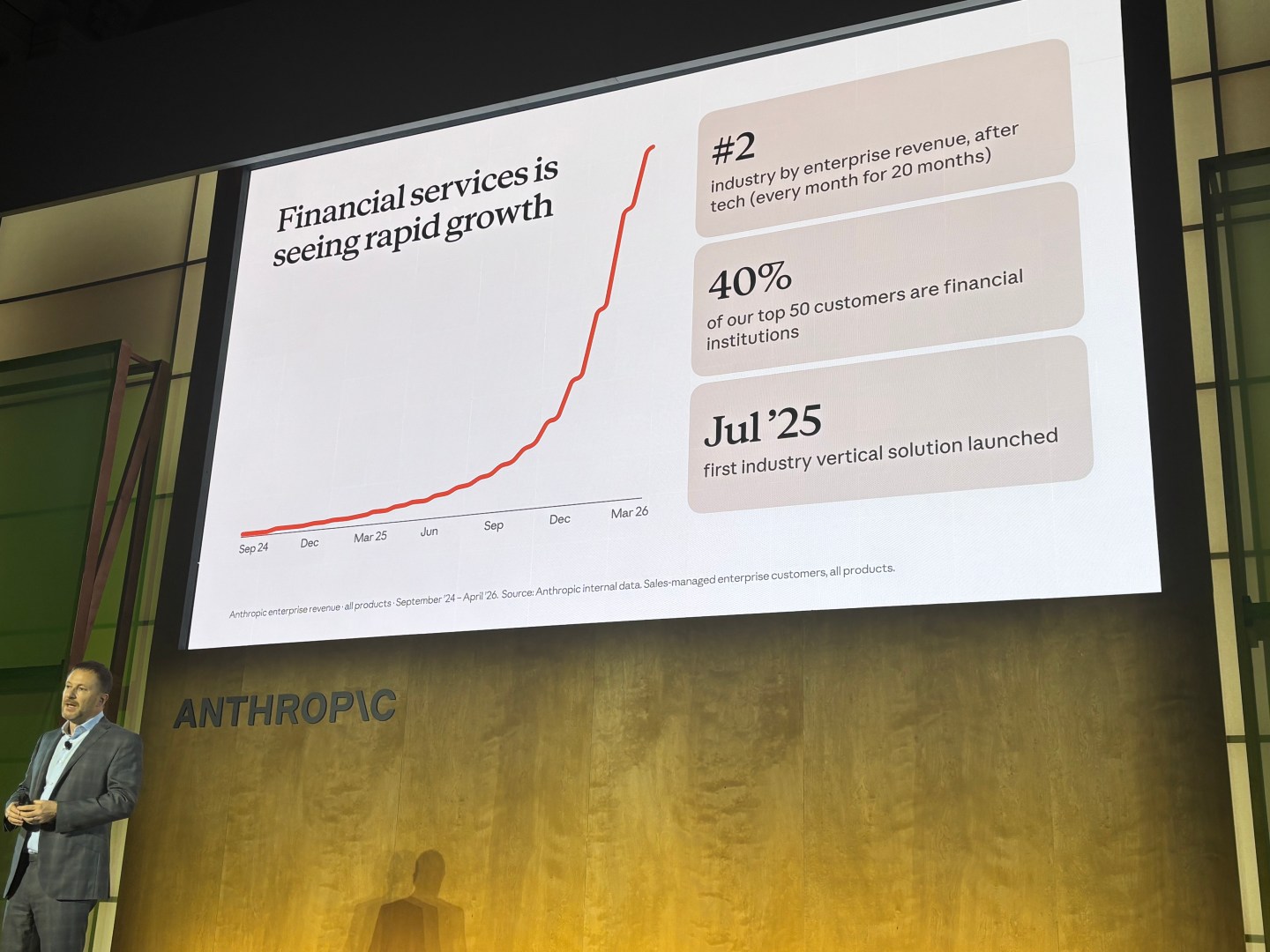
“Finance took off relatively later,” said Lisa Crofoot, a research product management leader at Anthropic, “but we believe we’re at the inflection point right now, about six months to one year behind coding.” She noted that less than a year ago, Claude “could barely format a table without ref errors,” and today, it’s doing senior analyst-level work.
Claude comes to Excel and Outlook
Anthropic is also rolling out full Microsoft 365 integration, enabling Claude to function as a single agent across Excel, PowerPoint, Word, and Outlook, carrying context across all four applications simultaneously. Add-ins for Excel, PowerPoint, and Word became generally available today. Claude for Outlook launched in beta.
The integration is a significant move for financial services firms, where analysts spend a large portion of their day toggling between spreadsheets, slide decks, and email.
Dramatically expanded data ecosystem
The announcement also includes new connectors to data sources already embedded in financial workflows. Verisk, Third Bridge, Fiscal AI, Dun & Bradstreet, Experian, GLG, Guidepoint, and IBISWorld all join an existing roster that includes LSEG, S&P Capital IQ, Morningstar, and PitchBook.
The marquee data partnership: Moody’s is embedding its full platform into Claude as a native app, enabling users to analyze credit ratings and risk data for more than 600 million companies without leaving the Claude interface.
Model built for finance
Underpinning all of it is Claude Opus 4.7, which Anthropic says now leads Vals AI’s Finance Agent benchmark with a score of 64.4% and tops the GDPval-AA evaluation for economically valuable knowledge work.
Since first launching Claude for Financial Services in July 2025 and expanding the platform later that year, Anthropic has placed Claude into production at JPMorganChase, Goldman Sachs, Citi, AIG, Visa, and others.
What the CIOs are seeing
The event’s closing panel, featuring Goldman Sachs CIO Marco Argenti, JPMorganChase CIO Lori Beer, and AIG CEO Peter Zafino, offered some of the most specific adoption data shared publicly by major financial institutions.
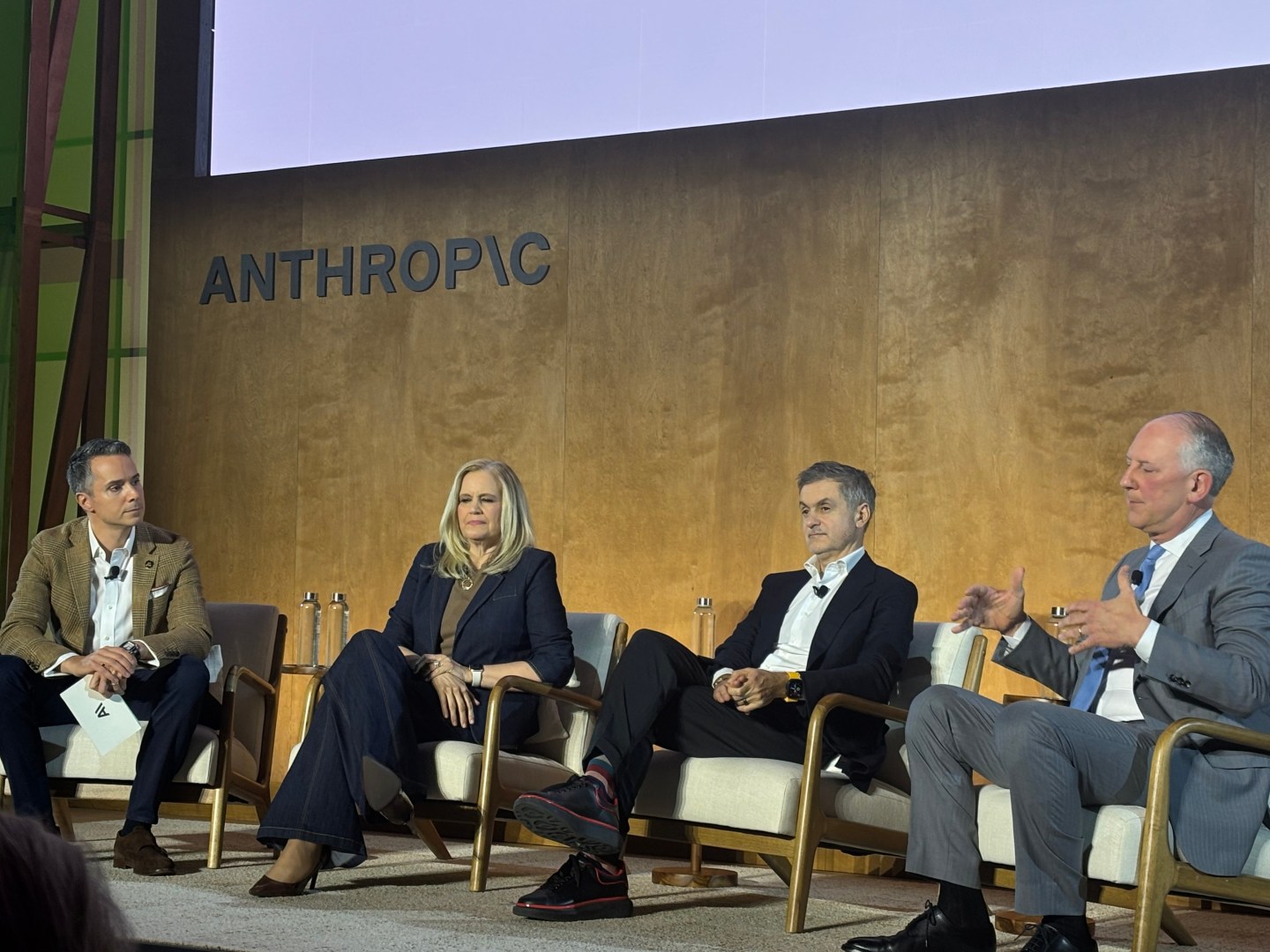
Argenti described three sequential waves of AI deployment at Goldman: first, empowering the technology team (roughly a third of the firm) to operate “at a completely different pace”; second, reimagining operational processes end-to-end; and third—more exciting in the long term, in his opinion—using AI to make better risk and investment decisions. “This is the first time that instead of buying infrastructure, you can actually buy intelligence,” he said. “It goes more profoundly into the way we operate, in the way we think.”
Zaffino disclosed a benchmark that his team ran: Claude out of the box scored 88% as accurate as a human expert on insurance claims. You can look at this two ways: “The theory is, can it get better? Yes. But that assumes that the claims expert doesn’t get better. And so I think it’s also a mechanism for people to learn and for very good questions.”
Beer described JPMorgan’s approach as rewiring the business end-to-end—across how it builds products, serves clients, and develops talent—and said the harder challenge isn’t the technology itself but organizational absorption. “There’s this capability overhang,” she said. “The technology can do so much. It’s the actual organization’s ability to digest and absorb it that tends to be where the gap is.”
Anthropic’s chief economist, Peter McCrory, added macroeconomic context: drawing on the company’s proprietary Anthropic Economic Index, he said AI is now being used for at least a quarter of tasks in roughly half of all U.S. jobs — up from one-third just a year ago. He projected that AI could add 1.8 percentage points per year to U.S. labor productivity over the next decade, turning back the clock to a better economy in recent memory. “This would roughly double recent run rates and bring us back to the productivity boom of the late ’90s and early 2000s.”
On the jobs question, prompted by a recent Wall Street Journal report suggesting AI could trigger 20%–30% unemployment, Dimon and Amodei both expressed uncertainty while rejecting fatalism. “I don’t think anyone knows,” Amodei said. “We need to prepare for the pessimistic case… even start to set policy, because that policy has a lag of two to three years, and the technology is moving so quickly.”
For this story, Fortune journalists used generative AI as a research tool. An editor verified the accuracy of the information before publishing.
#Anthropic #deepens #Wall #Street #push #agents #Microsoft #Moodys #partnerships