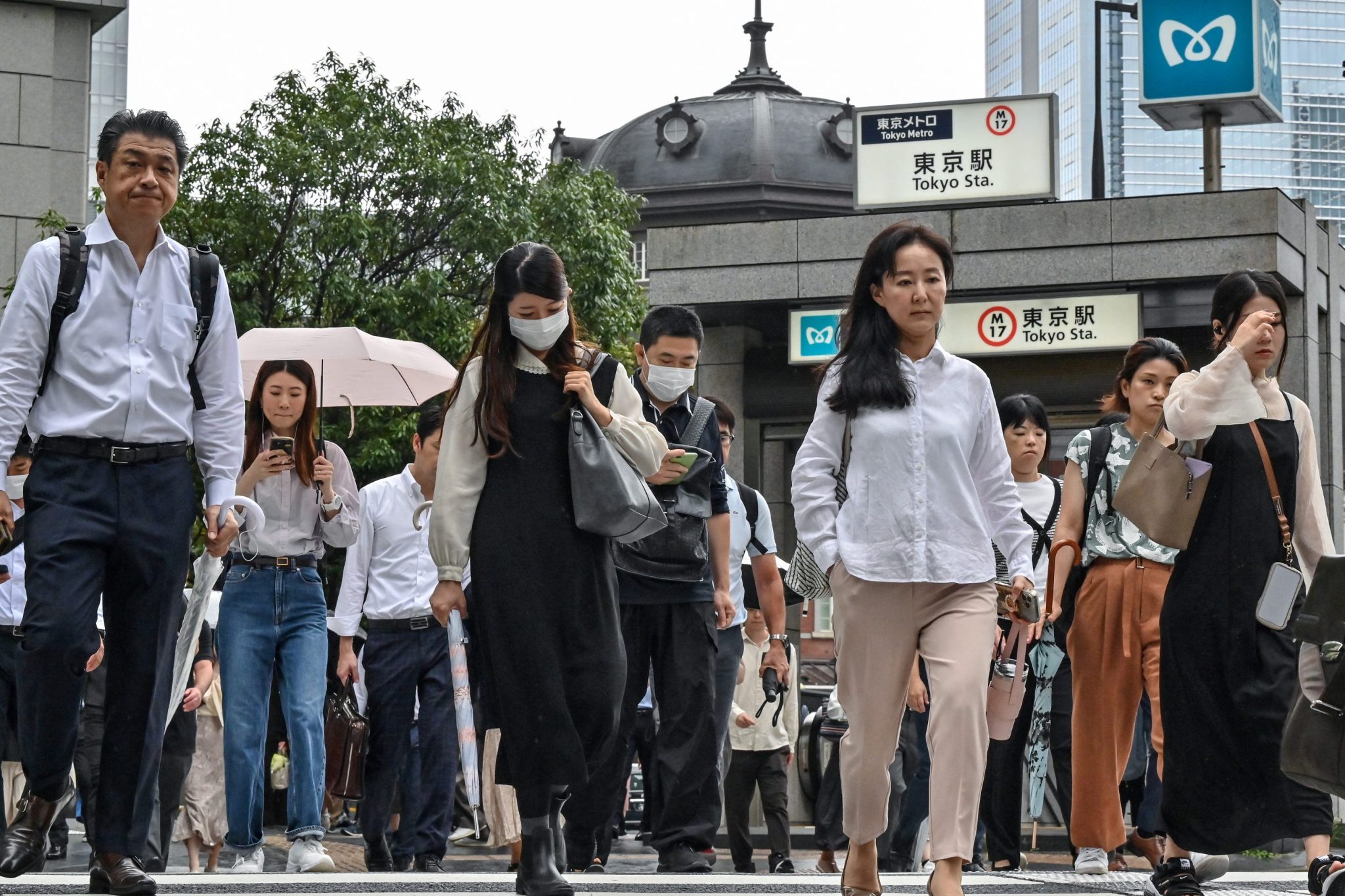
As the summer rolls in, many dreams of jet-setting vacations are being dashed as fuel prices spike during the ongoing war in Iran. But it’s not the only way people are pivoting—workers in Japan are even being asked to ditch the slacks and opt for bare-legged attire at the office.
The Tokyo metropolitan government recently began encouraging workplaces to wear shorts this summer as temperatures rise and energy costs continue to climb. The initiative is a remodel of Japan’s Cool Biz campaign launched by the country’s environment ministry in 2005, which called on civil servants to forgo ties and jackets, but didn’t permit shorts as an exception. Now, professionals are allowed to bare their legs at the office, and are also advised to stay cool and conserve energy in three target areas: work arrangements, daily habits, and clothing attire.
The city’s government employees have already started wearing T-shirts and shorts to beat the heat, according to The Japan News, with temperatures in Tokyo hovering in the mid-70s this week. Workers are also encouraged to take early-morning shifts and even work remotely, if permitted. And to bolster its safety system, Japan implemented a special heat stroke warning system just last month; the nation has been on high alert after a record of more than 100,000 citizens were sent to hospitals during Japan’s scorching summer months between May and September 2025.
Historically, Tokyo has shunned the notion of showing up to work in shorts. But it may be loosening the rules as environmental changes and global conflict force its hand. Temperatures have been rising across Japan; its warming between 2000 and 2020 even outpaced the global average, according to a 2021 study by the International Energy Agency. Plus, the country is currently embroiled in the ongoing tensions of the U.S.-Israel war with Iran. Japan sources around 95% of its oil from the Middle East, most of which travels through the Strait of Hormuz.
Shorts have long been a workplace taboo, deemed too risky a leap from traditional office attire. But just as Tokyo is adapting to its new reality, others may have to contend with changes of their own. Asia is even radically switching up its approach to work to accommodate; Vietnam has urged businesses to allow their staffers to clock in from home and “reduce the need for travel and transportation,” while the Philippines and Sri Lanka are also pushing for four-day workweeks in a bid to conserve energy.
The workplace shorts taboo—and how times are changing
White-collar workers are split on how to dress for the job. A whopping 41% of Americans said that it’s never appropriate for men to wear shorts in the office—no matter how hot the weather gets—according to a 2023 poll conducted by Ipsos and the Wall Street Journal. However, the tune on corporate attire may be changing in a post-COVID workplace being shaped by Gen Zers.
The pandemic fundamentally shifted the way people dress for work, Myka Meier, the founder of Beaumont Etiquette, a professional etiquette company, told Fortune in 2024. Before lockdown, button-up shirts and sensible heels were the norm; but after years of logging in from the couch in sweatpants and hoodies, many employees brought that same comfort back to the office post-RTO.
Then came Gen Z’s entry into the workforce. Many of the budding professionals graduated from college online, clocking into their remote internships during lockdown, with virtually no exposure to office attire. They didn’t experience work-dress culture before the pandemic, and now have an even murkier idea of what the rules really are. Hazel Clark, professor of design and fashion studies at Parsons School of Design, told Fortune that Gen Z and millennials have ushered in a new era of relaxed workwear.
“Younger generations do and will dress more casually, and it’s having an impact,” Clark said in 2024. “The possibility of wearing a turtleneck or an unbuttoned shirt—that is happening. Things will change as more young people come into the corporate workplace.”
Now, even the question of shorts may be on the bargaining table. Professors and professional skills experts mostly agree that shorts are not a safe choice for the office; Myka Meier, the founder of Beaumont Etiquette, told Fortune that the leg-baring attire is “a slippery slope” due to the variations in length. And without any collective standard on what’s “too short” or workplace appropriate, problems are bound to arise. One job-seeker even went viral in 2024 for showing up to an interview wearing shorts in the August heat. The recruiter saw her outfit and asked to reschedule in different clothes; the candidate refused, and the internet was ablaze with debate.
But not all hope is lost to defeat the heat in cropped bottoms. Lisa Z. Morgan, chair of fashion design at the Pratt Institute, told Fortune she believes that there are scenarios in which shorts can be styled appropriately for work, considering that they come in different lengths. But she still advises employees to use their discretion.
“It depends on the shorts, and I suppose it depends on the job,” Morgan said. “I wouldn’t suggest hot pants for meetings. But there are codes which I do believe can be broken.”
#Tokyo #throwing #strict #office #dress #code #workers #wear #shorts #war #Iran #energy #crisis