Jim Cramer has a habit of cutting through the noise and pointing at something most investors are overlooking.
On May 4, he did it again. In a X post, the “Mad Money” host wrote: “Oracle and SanDisk have become the tells of this market.”
That’s a bold claim. But when you look at what these two companies are doing right now, the logic becomes hard to dismiss. One is selling the infrastructure on which Artificial Intelligence (AI) runs. The other is selling the memory that AI can’t function without.
Both are supply-constrained. Both are surging. And both are flashing signals about where the entire tech sector is heading next.
Why SanDisk has become one of the most extraordinary stock stories of 2026
SanDisk (SNDK) is up 429% year-to-date. The one-year return stands at 3,550%, according to Yahoo Finance. You might think those numbers are typos, but they are not.
The 37-year-old company headquartered in Milpitas, California, United States, made a decisive strategic move. It shed its legacy hard-disk drive business entirely and went all in on high-density NAND flash and solid-state drives for data centers. The results have been staggering.
In its fiscal third quarter of 2026, SanDisk reported revenue of $5.95 billion. That was up 97% sequentially and above its own guidance range, according to Sandisk’s April 30 earnings release.
Datacenter revenue specifically surged a massive 233%. Gross margins are expanding toward 80%. The company ended the quarter with a zero debt balance sheet and a newly authorized share repurchase program.
More Tech Stocks:
- Morgan Stanley sets jaw-dropping Micron price target after event
- Nvidia’s China chip problem isn’t what most investors think
- Quantum Computing makes $110 million move nobody saw coming
Fourth-quarter guidance calls for revenue of $7.75 billion to $8.25 billion, with non-GAAP diluted earnings per share of $30.00 to $33.00, according to the same release.
“This quarter marks a fundamental inflection point for SanDisk,” said CEO David Goeckeler. “Our technology leadership is enabling a deliberate shift in our mix toward the highest value end markets, led by Datacenter.”
SanDisk matters even beyond its own stock
NAND flash manufacturing capacity for 2026 is essentially sold out, according to Forbes. A bidding war has emerged for memory. Average selling prices are projected to rise 70% to 75% in the second quarter of 2026.
Companies that secured supply agreements are charging premium prices. According to Reuters, SanDisk locked in five long-term contracts, three of which are worth a combined $42 billion in long-term supply agreements.
Related: Morgan Stanley resets SanDisk stock forecast ahead of earnings
So now, it is fair to say that Sandisk has become one of the biggest beneficiaries of the artificial intelligence boom, if not the biggest. Everyone else is scrambling.
The flip side is real pain for companies that buy memory rather than sell it. PC makers, smartphone manufacturers, and cloud providers that didn’t secure long-term supply deals are facing severe margin compression. SanDisk’s gain is someone else’s earnings problem.
Oracle’s $553 billion backlog is the other signal Cramer wants investors to watch
If SanDisk tells you about memory, Oracle (ORCL) tells you about compute. And the Oracle story right now is one of the most underappreciated in enterprise tech.
The 48-year-old stock company headquartered in Austin, Texas, United States, closed at $180.29 on May 4, up 4.92% on the day. The stock is down 6.93% year-to-date but up 20.81% over the past year, according to Yahoo Finance.
The numbers in Oracle’s most recent earnings tell a different story than the year-to-date return suggests.
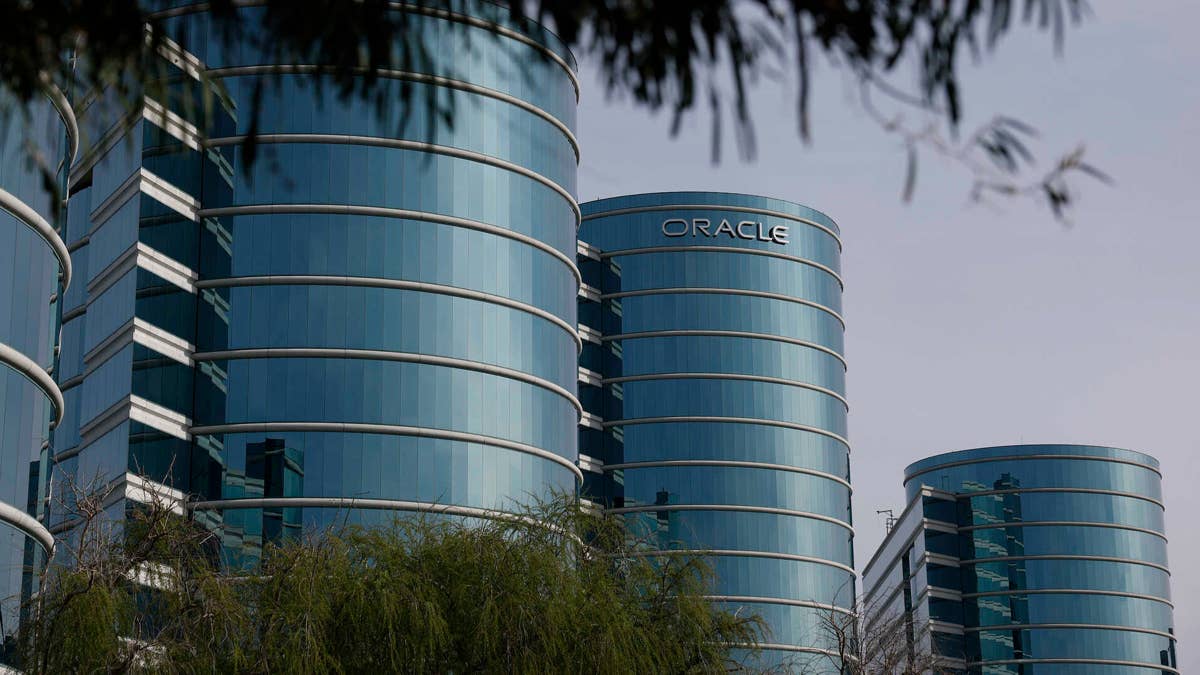
Justin Sullivan/Getty Images
Oracle’s fiscal third-quarter of 2026 reported:
- Total revenue of $17.2 billion, up 22% year over year
- Cloud infrastructure revenue of $4.9 billion, up 84% year over year
- GAAP Earnings per Share up 24% to $1.27
- Non-GAAP Earnings per Share up 21% to $1.79
- Remaining performance obligations of $553 billion, up 325% year over year,
Source: Oracle Fiscal Year 2026 Third Quarter Financial Results.
That last number is the one Cramer is likely watching. A $553 billion backlog means demand for Oracle’s cloud and AI infrastructure is so intense that the company has years of contracted revenue already sitting on the books.
The constraint is not demand. The constraint is Oracle’s ability to build fast enough to fulfill it. Oracle raised its fiscal year 2027 total revenue guidance to $90 billion. Fourth quarter cloud revenue is expected to grow 46% to 50%, according to company guidance.
“The demand for cloud computing for AI training and inferencing continues to grow faster than supply,” Oracle said in its guidance commentary. “These market dynamics enable Oracle to comfortably meet and likely exceed our revenue growth rate forecast for FY27 and beyond.”
What Oracle and SanDisk together are telling the market
Cramer’s insight is about what these two companies signal collectively, not just individually.
SanDisk shows that memory, once a commodity, is now mission-critical infrastructure. Oracle shows that cloud capacity for AI is being contracted years in advance. Both companies are operating in supply-constrained environments at a moment when AI demand shows no sign of slowing.
For investors, the message is simple. When the infrastructure layer of the AI boom is sold out, and backlogs are measured in hundreds of billions of dollars, the companies sitting at that bottleneck tend to define the market’s direction. That is what Cramer is pointing at. And the data is backing him up.
Related: Morgan Stanley revamps Oracle stock price target
#Jim #Cramer #stocks #decide #stock #market039s #move