A simple board game made from a pizza box, first sold at a market day, has grown into a nationally distributed product aimed at tackling one of South Africa’s most persistent challenges – financial literacy.
FinMaster is an internationally recognised educational game developed by two industrial engineers, Elijah Djan and Danei Rall. The board game, reminiscent of Monopoly, is now available locally after nearly two years of development and testing.
Read:
Pocket money with purpose: Teaching children early
Incentives alone will not solve SA’s household savings challenge
At a launch event at Exclusive Books in Cape Town, Rall shared how her mother had to work hard to rebuild her life after a divorce. As a young girl, she promised herself she would “figure out this money thing” and make sure she would be financially independent when she grew up.
But the duo’s idea did not start as a game.
Djan and Rall initially ran financial wellness programmes for workers, where they encountered a recurring pattern – people approaching retirement who were budgeting for the first time.
One interaction stayed with Djan: a worker said it was too late for him to change his financial habits, but that he would pass the material on to his children.
That moment shifted things and Djan and Rall decided to start looking for ways to introduce financial concepts earlier in life – before habits were formed.
Read: Money lessons inspired by Nelson Mandela [Jul 2025]
Their first idea was to build an app.
“It’s a common principle that before you do anything, you find the simplest way of solving a problem – then you build your business case around that,” says Djan. “But with so many apps in South Africa we did not want to rush into things.”
One of their ideas to solve the financial literacy problem in South Africa was through a board game.
ADVERTISEMENT
CONTINUE READING BELOW
They developed a prototype on a pizza box, which caught the attention of attendees at a conference in the Netherlands.
“Going to the conference, we took our screenshots and mock-ups of the app we wanted to build – and our pizza box game. One woman there wanted it so badly, she paid us in cryptocurrency!” Rall recalls.
That’s when the two realised people were intrigued by the board game.
What followed was an intensive process of testing and redesign. The pair would run play sessions on Friday nights, gather feedback, and adjust the game before testing again – repeating the cycle dozens of times.
In total, the game went through more than 25 iterations over roughly 18 months before reaching its current form.
How the game works
FinMaster is a light strategy board game designed for players aged around 13 and up.
Unlike traditional property-focused games, such as Monopoly, FinMaster is about broader financial decision-making – including saving, investing and managing risk.
Players build portfolios across different asset classes while navigating real-world challenges, such as unexpected expenses, economic shifts, a market crash, and even uniquely South African challenges like load shedding.
“There’s no definite strategy that will make you win the game,” Djan says. “Just like in the real world, life happens. It helps people understand risk.”
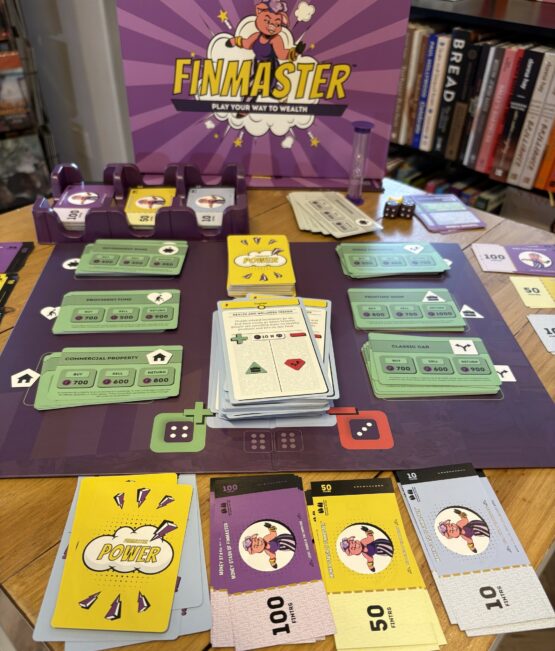
FinMaster teaches budgeting and financial navigation through local real-life scenarios. Image: Liesl Peyper/Moneyweb
ADVERTISEMENT:
CONTINUE READING BELOW
Real-world impact
The founders say the game is designed to go beyond entertainment.
Parents have reported that children begin asking questions about money after playing, while some young adults have taken practical steps such as opening savings or investment accounts.
Read: The greatest gift you can give your children isn’t money. It’s a healthy relationship with it
Djan recounts one example of a player who, after a single session, went on to open an investment account within days.
The game has already gained international recognition, placing second in the International Educational Games Competition in Norway in 2025.
Locally, it is now available at Exclusive Books stores nationwide as well as online platforms and select retailers for around R800.
But the founders’ already have bigger ambitions.
They are planning a junior version aimed at younger children, and considering a broader ecosystem of educational games – potentially including digital formats in future.
Read: What children’s books can teach us about money
FinMaster is already available in selected stores in the east coast of the United States and the founders are also working on a Norwegian and French version of the game.
#Play #wealth #pizzabox #idea #financial #toolkit