For decades, McDonald’s has set the standard for kids’ meals in the fast-food industry, and despite repeated efforts, competitors have struggled to replicate its success.
The Happy Meal is more than just a bundle offering; it is a global brand asset. Through strategic partnerships with recognized brands, collectible toys, and experience-driven packaging, McDonald’s established a deep emotional connection with younger customers and adults alike.
Today, the company sells more than 1 billion Happy Meals worldwide each year, representing a significant portion of its overall business.
Rivals such as Burger King and Wendy’s have introduced their own versions of kids’ meals over the years. However, none have matched McDonald’s ability to sustain long-term demand or brand loyalty at scale.
Now, a fast-growing regional competitor is making a renewed push into the space, with a redesign offering that could challenge the beloved McDonald’s Happy Meal.
Whataburger unveils the new Kids Whatameal
Whataburger is revamping its long-standing kids’ meal with the launch of the “Kids Whatameal,” marking its most significant update to the offering in more than seven decades.
The refreshed version features new orange-and-white branded packaging with games and mazes to create a more interactive experience. Each meal will also include a rotating collectible toy or surprise item, encouraging repeat visits. The initial release includes exclusive sticker packs featuring five unique designs.
The kids’ meal menu will still include:
- A choice of the Justaburger, 2-piece Whatachick’n Strips, 4-piece Whatachick’n Bites, or Grilled Cheese
- Small fries or a Mott’s Applesauce
- A kid’s-sized drink
- A sweet treat
“This new Kids Whatameal brings a little more fun to those moments, giving families another reason to slow down, enjoy the time together and leave with a smile,” said Whataburger Chief Marketing Officer Scott Hudler.
The updated meals will be available at all Whataburger locations starting May 5, with pricing ranging from $3.89 to $6.49, depending on the entrée, according to the company announcement.
The timing is strategic. Kids’ meals are no longer just a tool to attract families; they are increasingly purchased by adults seeking smaller portions at a lower price point, making them a broader value play.
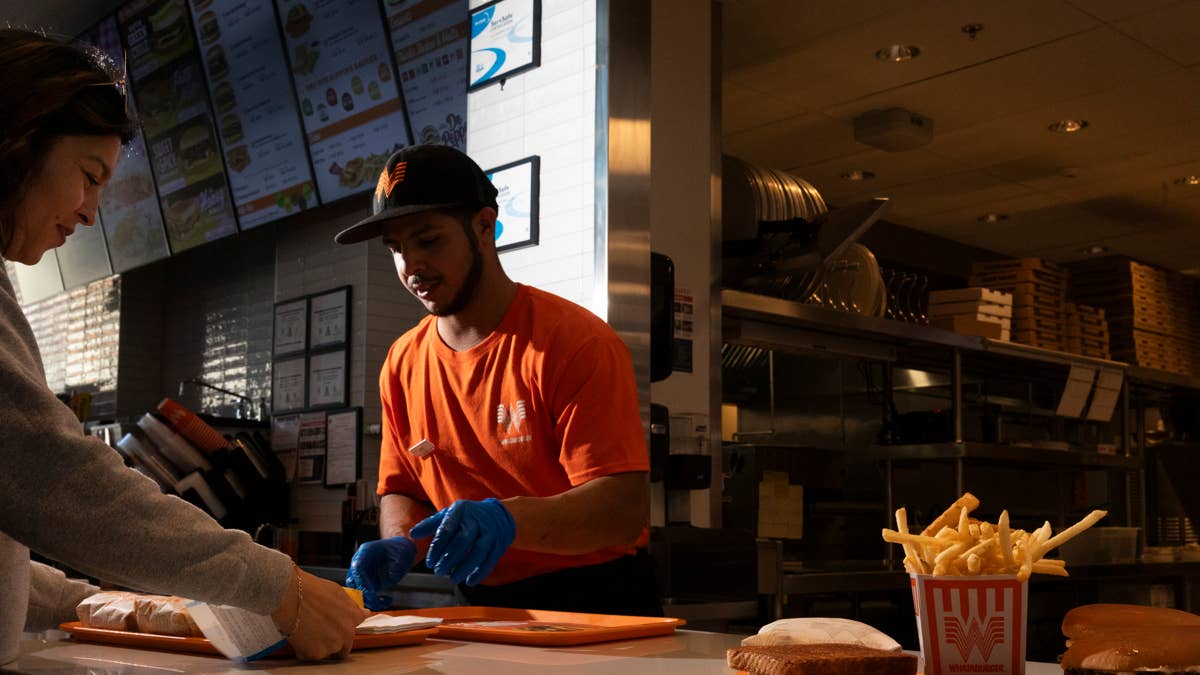
Mikayla Whitmore for The Washington Post via Getty Images
Brand identity: Whataburger vs. McDonald’s
Both Whataburger and McDonald’s have built enduring brand identities that extend far beyond their menus, but their strategies differ significantly.
Whataburger is known for its distinctive orange-and-white striped restaurant design, large illuminated “W” signage, and reputation for Southern hospitality. Its 24-hour service and made-to-order model have helped it build a strong following, particularly across the southern U.S.
McDonald’s (MCD), by contrast, has achieved unmatched global scale. Its iconic Golden Arches, red-and-yellow color scheme, and “I’m lovin’ it” slogan are among the most recognized brand elements in the world. Its consistency, operational efficiency, and global reach have led it to grow to more than 45,000 locations across over 100 countries.
While Whataburger operates more than 1,100 restaurants across 17 states, its smaller footprint allows it to focus on regional brand affinity, an area where it continues to compete effectively, despite its size disadvantage.
Why kids’ meals remain a powerful growth driver
Kids’ meals have long served as a strategic tool for fast-food chains to attract families and build early brand loyalty.
By combining smaller portions, bundled pricing, and engaging packaging, they appeal directly to children while simplifying parents’ decision-making. Over time, this creates familiarity that can influence kids’ dining preferences well into adulthood.
Beyond branding, kids’ meals also deliver practical value. Bundled pricing offers a predictable, often lower-cost option for families, making it especially appealing to budget-conscious consumers amid rising menu prices.
The evolving role of value in fast food
The importance of value in fast food has intensified in recent years as inflation continues to reshape the industry and consumer behavior.
Prices for food away from home increased 3.8% in the 12 months ending March 2026, according to recent data from the U.S. Bureau of Labor Statistics.
More related food industry business coverage:
- Buffalo Wild Wings closes restaurants across the U.S. in 2026
- McDonald’s is eliminating a popular customer perk nationwide
- Fast-food burger pioneer chain closes its final location
- McDonald’s drops 6 new drinks and a surprising fashion collab
At the same time, overall traffic in the food service industry declined by 1% in the quarter ending June 2025, according to Circana.
In response, major chains, including McDonald’s, Burger King, Taco Bell, and Wendy’s, have expanded value menus and promotional offerings to maintain customer engagement.
Notably, value menu traffic has recently returned to growth, rising 1% after several years of decline, according to Circana.
Kids’ meals are playing an increasingly important role in this shift. Circana reports that adults ordered 28% more kids’ meals in 2024 than in 2019, even as overall restaurant visits fell.
“Although smaller than standard meals, kids’ meals satisfy that fast-food craving at a fraction of the price,” said Food Republic industry writer Cheryl Kochenderfer.
Value is no longer defined solely by price, emphasized David Portalatin, senior VP and industry advisor for food and foodservice at Circana.
“Operational excellence in providing quality, affordability, great experiences, and convenience is what leads winning restaurants and their supply chain partners to greater success,” Portalatin added.
What a new kids’ meal means for the fast-food industry
While McDonald’s continues to dominate the kids’ meal category through scale and brand equity, Whataburger’s updated Kids Whatameal signals renewed competition in a space that remains highly influential.
As inflation reshapes consumer habits and smaller, lower-cost options gain appeal, kids’ meals are evolving into one of the most effective value strategies in the industry, attracting not just families, but also adults seeking more affordable options.
The next phase of competition won’t just be about toys or packaging, but also about which brands can deliver affordability, experience, and emotional connections simultaneously.
Related: McDonald’s is eliminating a popular customer perk nationwide
#76yearold #burger #chain #takes #McDonalds #Happy #Meal