Artificial intelligence is supposed to be the engine of the next great productivity boom. But before it gets there, it’s going to cost you — and a growing number of Americans, especially young ones, are starting to wonder if that payoff will ever arrive.
That’s the converging picture across Wall Street research and Main Street sentiment. Goldman Sachs, J.P. Morgan Asset Management, and Stifel all recently agreed that the AI buildout is inflationary right now, and the technology’s promised productivity dividend remains elusive. Meanwhile, some of the sharpest critics are calling the whole thing a bust, and the workers being sold AI the hardest are pushing back the hardest.
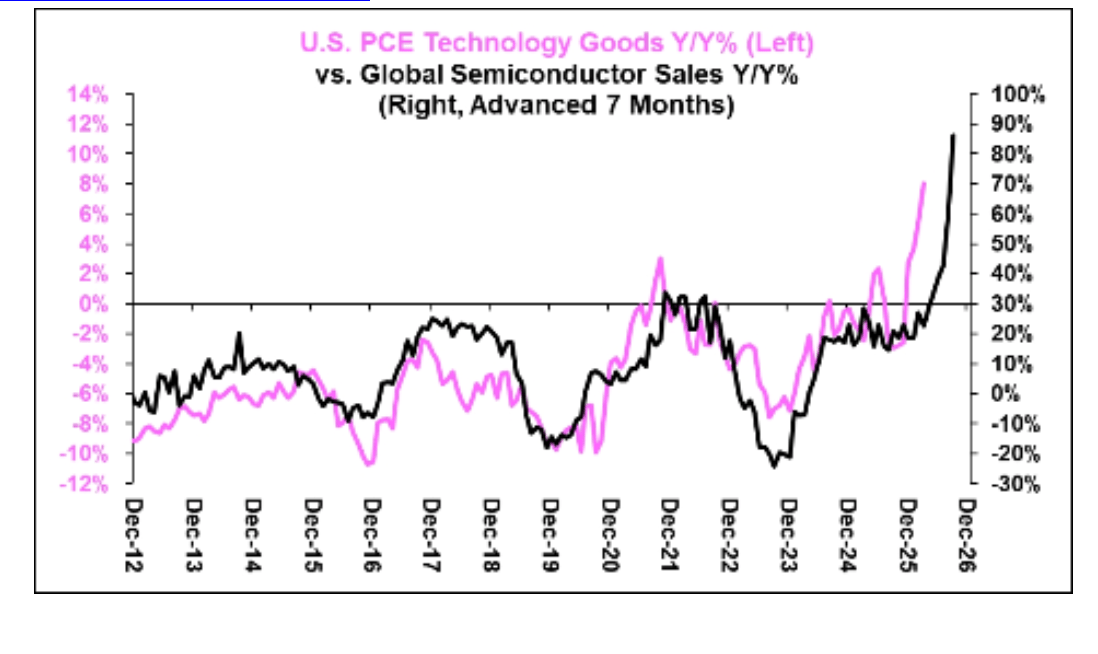
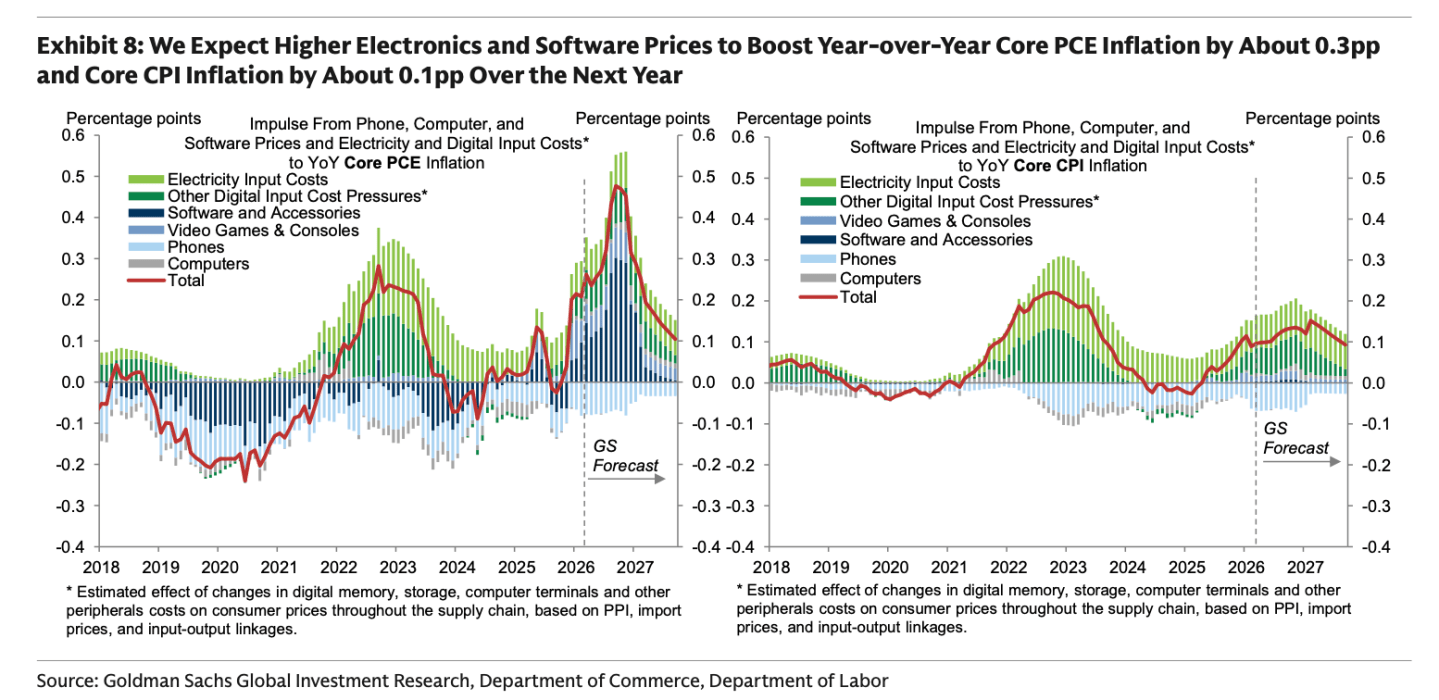
Goldman Sachs sees AI eventually cooling off inflation, but in research note published Monday economist Manuel Abecasis estimated that AI-related price pressures have already added roughly 0.3 percentage points to annual core PCE inflation and 0.1 percentage points to core CPI over the past year. He forecasts the same added pressure over the next 12 months. Stifel’s Thomas Carroll, in a note published Sunday, called this a macro “regime shift,” flagging that 2026 marks the first time in 65 years that tech goods prices are rising faster than wages.
The findings point to three channels through which the AI boom is putting upward pressure on inflation.
The hardware squeeze
The first inflationary channel runs through electronics. Surging demand for AI infrastructure has driven up prices for key inputs — particularly digital memory and storage batteries — creating ripple effects across the consumer electronics supply chain. Goldman’s equity analysts forecast average selling prices for computers and non-Apple smartphones will rise by roughly 10% this year.
J.P. Morgan Asset Management chief global strategist David Kelly noted that memory chip prices have soared due to AI buildout demands, raising costs for manufacturers of laptops, smartphones, and even automobiles. But he cautioned that only some of these costs are currently being passed through to consumers.
“In the short run,” Kelly argued, “the tsunami of spending dedicated to AI development is likely inflationary rather than deflationary, as the extra demand is hitting the economy in advance of the productivity payoff.”
Software subscriptions are getting pricier
The second channel is software. Companies have used AI feature upgrades as cover to push through significant subscription price hikes. Microsoft raised the price of its M365 personal monthly subscription by 30% in January 2025 — the first such increase ever. Adobe raised Creative Cloud Photography prices by 50% soon afterward. Intuit hiked QuickBooks by 45% in August 2025.
Goldman noted that these increases are showing up in inflation statistics without any corresponding quality adjustment, meaning the added value of AI features is counted as a pure price increase, not an improvement in what consumers are receiving.
Your electric bill
The third channel is electricity. Data centers powering the AI boom are consuming enormous amounts of power. Kelly noted that after more than a decade of flat U.S. electricity production, output rose 2.5% in 2024, 2.4% in 2025, and was up 3% year over year in March 2026.
Much of that driven by data center demand, contributing to a 4.6% year-over-year rise in consumer electricity prices. Goldman estimated that electricity costs will add 0.1 to 0.2 percentage points to headline PCE inflation over the next couple of years.
The skeptics: ‘Buckle your seat belt’
Not everyone accepts the premise that the inflationary pain will eventually give way to a productivity payoff. Johns Hopkins economist Steve Hanke told Fortune in April that AI “didn’t deliver” on its promised boom: “Welcome to the real world. Forget the AI bubble. You know, it didn’t deliver,” echoing remarks several months earlier to Business Insider that it was “overhyped and potentially dangerous.”
This aligned Hanke with Meta’s former chief AI scientist Yann LeCun, who has argued that large language models have a “very superficial” grasp of reality. Hanke has previously compared the AI boom to the dot-com bubble, and advised investors to “buckle your seat belt.”
That skepticism has some data behind it. As of March, Goldman had found no meaningful relationship between AI and economy-wide productivity, although the bank noted isolated gains of around 30% on specific tasks where companies were actively measuring. An earlier Goldman analysis showed that $700 billion in AI investment during 2025 had contributed essentially zero to U.S. GDP growth.
A generation that isn’t buying it
The workers being asked to embrace AI most aggressively — Gen Z — are growing increasingly hostile to it. Gen Z’s excitement about AI dropped 14 percentage points over the past year to just 22%, according to an April Gallup poll, while anger rose 9 points to 31% and anxiety held steady at 42%. The backlash is sharpest among daily users, suggesting the more closely young workers interact with AI, the less they trust it.
The frustration has turned behavioral. Forty-four percent of Gen Z workers admit to actively sabotaging their company’s AI rollout by entering proprietary data into public tools, refusing to use AI outright, or intentionally producing low-quality AI outputs to make the technology look ineffective.
This is in part a verdict on institutions that promised AI would create opportunity but are instead using it to compress the career ladder that Gen Z was supposed to climb. But the widespread economic evidence suggests it’s also just making things more expensive in an inflationary 2020s environment.
A Wharton-led survey published in January added another dimension: Gen Z judges colleagues who lean on AI tools, believing the technology is making coworkers “dumb and lazy” and eroding critical thinking in the workplace.
The disinflationary payoff — eventually
Goldman frames this as an “up then down” story. Once AI productivity gains become widespread, the firm expects the technology to turn disinflationary, consistent with historical patterns where productivity booms put downward pressure on prices before higher wages offset the gains. Kelly takes an even longer view, arguing that AI will weaken labor bargaining power and make price comparison easier for buyers — both disinflationary forces.
But Kelly delivered a pointed warning for those who might use AI’s long-run promise to justify near-term Fed rate cuts. He estimated year-over-year PCE inflation could hit 3.9% by May, nearly double the Fed’s 2% target, with the productivity payoff is still years away.
The St. Louis Fed published a working paper in March warning that if the Fed eases too early because of AI optimism and the productivity gains don’t materialize on schedule, the result could be “inflation that remains persistently elevated above target even after the supply-side improvements materialize.”
Stifel, meanwhile, warned that the economy is rotating into a “run hot” regime that favors investment over consumption, putting further pressure on the consumers already absorbing AI’s inflationary costs.
“We believe the economy is shifting into an Inflationary Boom,” Stifel’s Carroll wrote, with hot inflation and a low hire/fire job market combining to exacerbate weak real incomes for consumers. This makes 2026 a “tale of two economies,” with investment on the rise but consumption slowing.
For now, the AI era has an inflation problem, a credibility problem, and a growing constituency that isn’t willing to wait around to find out if it all works out.
#Goldman #save #economy #stop #inflating